
Why is UX design crucial for modern brands
Why UX design is crucial for modern brands
UX design can transform the future of your brand. In Switzerland, where users are demanding and expectations are high, following UX design principles is no longer an option, it's a priority. Here's why:
- 88% of consumers do not return after a bad experience.
- Poor usability accounts for 70% of online failures.
- Every franc invested in UX can generate a return on investment of 100 francs.
A good UX design, like the one adopted by Virgin America, reduces friction, improves conversions (+14%), and reduces costs (20% fewer calls to customer service). Conversely, a confusing navigation or poorly designed site can harm your credibility and drive away customers.
What's at stake? Your revenue, your image, and your customers' loyalty. Investing in UX ensures an experience that meets user expectations while enhancing your company's commercial performance.
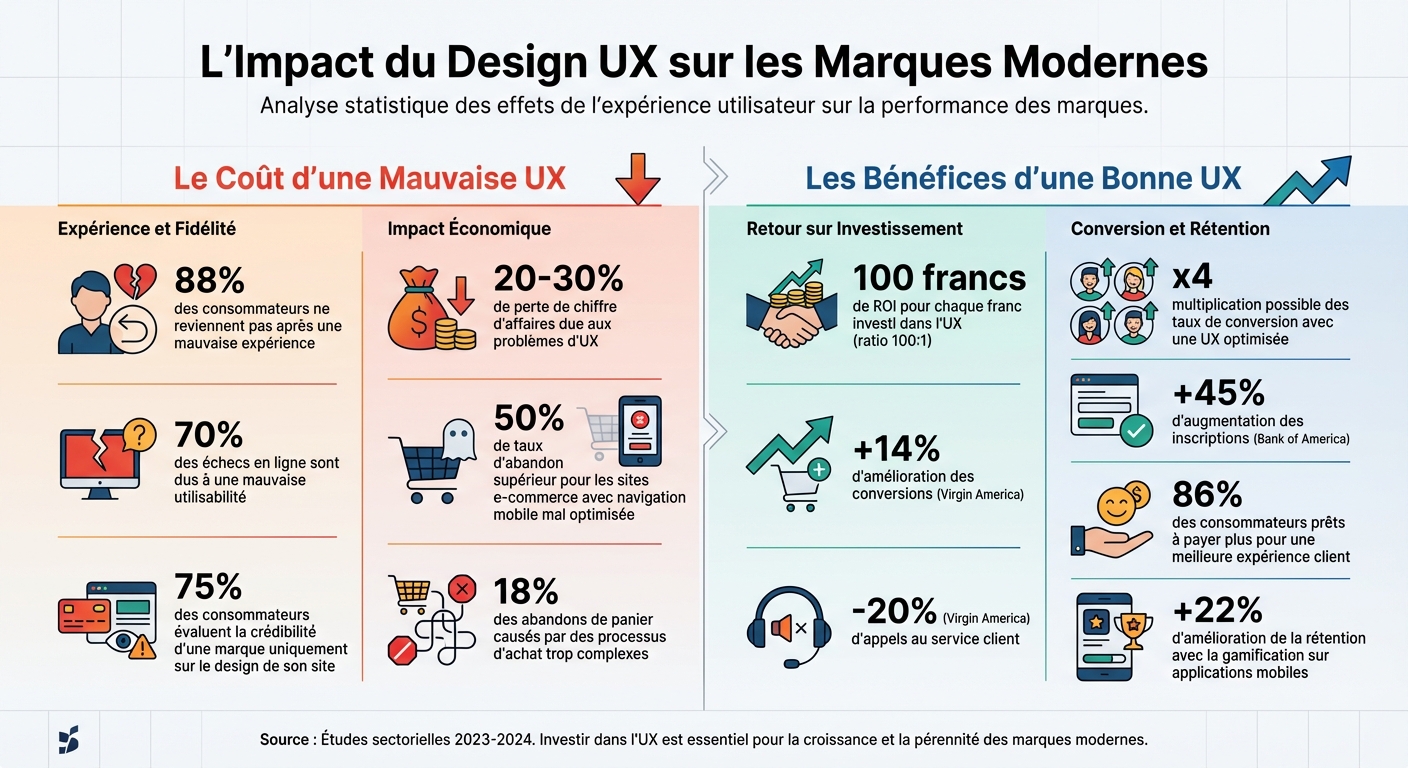
Impact of UX design on brand performance: key statistics
Common UX design issues that harm brands
Poor navigation drives users away
Poorly thought-out navigation is a recurring problem that causes users to leave a site within seconds. Confusing menus, inconsistent layouts across pages, or poorly placed calls to action increase cognitive load, quickly frustrating visitors[2]. On mobile, these issues are even more pronounced: small screens and touch interactions amplify errors. Users don't search for information for long – they prefer to turn to a competitor offering a more intuitive experience.
For example, e-commerce sites that hide their main categories in hamburger menus on mobile experience abandonment rates 50% higher compared to those optimized for easy thumb navigation[4]. Each obstacle in the user journey results not only in a loss of engagement but also in a negative impact on revenue and brand image. These initial frustrations can also lead to lasting mistrust towards the brand.
Poor design undermines trust in the brand
The appearance of a website instantly influences users' perception of a company. In fact, 75% of consumers evaluate a brand's credibility solely based on its site design[3]. A visually outdated site, riddled with technical errors, spelling mistakes, or awkward translations immediately raises doubts about the company's reliability. This leads users to ask a simple question: if a brand neglects its online image, can it really be trusted for its products or services?
Cluttered designs, with unnecessary animations, superfluous gadgets, or hard-to-read fonts, dilute the main message and slow down the site. This visual overload gives an impression of amateurism and prevents users from feeling secure when they need to share sensitive information or make a payment. Furthermore, the absence of a responsive mobile version sends a clear signal: the brand is out of touch with current expectations.
Weak UX reduces sales and customer loyalty
UX issues not only affect brand image; they directly impact sales. Complicated ordering processes, poorly designed forms, or excessively long loading times discourage customers. These obstacles can lead to a 20 to 30% loss in revenue[3]. And the impact doesn't stop there: a frustrating experience dissuades customers from returning.
This lack of consistency creates a digital mess that gradually degrades the customer experience and diminishes loyalty. In a competitive environment, users naturally prefer brands that offer , even if the products or services are similar[2][5]. An optimized user experience is therefore not a luxury but a necessity to remain competitive.
sbb-itb-454261f
How good UX design benefits modern brands
Better engagement and user satisfaction
A well-designed UX changes the way users interact with a brand completely. Simple and intuitive interfaces encourage visitors to explore more, stay longer on pages, and interact naturally with the content. This fluidity meets user expectations without frustrating them.
When users quickly find what they're looking for without unnecessary effort, their satisfaction soars. Details like well-thought-out micro-interactions, pleasant typography, and a welcoming tone make the digital experience more human. In a world where competition is just a click away, this emotional connection can make all the difference. Better user satisfaction often translates into improved business results.
Higher conversion rates and returns on investment
An effective UX design can have a direct and measurable impact on business performance. For example, an optimized user experience can quadruple conversion rates[1]. These impressive results are often due to elements like well-positioned call-to-action buttons, simplified forms, and frictionless purchase journeys.
A telling example: after a UX redesign, Bank of America saw a 45% increase in sign-ups[1]. Additionally, addressing issues during the design stages (wireframes, prototypes) helps reduce long-term development costs. Search engines also favor well-designed sites: pages that load quickly (under 3 seconds), low bounce rates, and navigation suitable for all devices boost . This creates a virtuous circle between good UX and better online visibility.
Increased loyalty and customer recommendations
A successful UX design not only satisfies users in the moment; it turns them into true brand ambassadors. In fact, 86% of consumers are willing to pay more for a better customer experience[6]. By eliminating irritants, such as overly complex purchasing processes (responsible for 18% of cart abandonments[7]), well-thought-out UX simplifies users' lives.
Furthermore, consistent design across all platforms – whether websites, mobile apps, or other touchpoints – strengthens the brand's identity. This visual and functional consistency enhances memorability and encourages satisfied customers to recommend the brand to others. A smooth and pleasant experience fosters loyalty while attracting new users through word of mouth.
Key UX and UI trends for 2025!
Practical solutions to improve UX design
To stay competitive, brands must engage in well-thought-out and adaptable user experience (UX).
Putting the user at the center
Start by analyzing user behaviors, goals, and frustrations. This can be done through interviews, questionnaires, or direct observations. These data will help create an interface that truly meets their expectations [9] [10].
Wireframes and prototypes are valuable tools for detecting usability issues before development even begins [9]. By integrating them from the start, you can adjust and improve the experience from the early stages. Usability tests, on the other hand, help identify real issues, rather than relying solely on assumptions [11]. To go further, use tools like heatmaps or session recordings to identify obstacles. Also, remember to integrate accessibility from the beginning: think of clear typography, sufficient contrast, and compatibility with screen readers. This not only expands your audience but also meets ethical and legal requirements [8] [9].
Once these needs are well defined, design an interface that works harmoniously across all platforms.
Thinking about multiple languages and devices
With the majority of users browsing on mobile, a mobile-first approach is essential. This means your interface must be fluid and adapt to all screen sizes, avoiding frustrations. Simple and readable typography, combined with high contrast, ensures comfortable reading, even on small screens.
Navigation should remain intuitive. Well-organized menus and breadcrumb trails help users navigate easily. Call-to-action buttons, like "Buy Now" or "Discover," should be prominent and formulated with impactful and action-oriented words. Finally, technical performance should not be overlooked: compress images, lighten the code, and use a content delivery network (CDN) for fast loading times.
Observing behaviors and constantly adjusting
UX optimization doesn't stop after launch. Continue to analyze user behavior to improve the experience. Tools like Google PageSpeed Insights can help you quickly detect and correct performance issues. Data analysis reveals valuable information, such as the most visited pages, bounce rate, or user journey drop-off points.
Artificial intelligence can also be an ally in personalizing content or creating dynamic dashboards tailored to user behaviors [9]. Gamification is another effective method: by integrating rewards or progress tracking, you turn mundane tasks into engaging experiences. For example, this can improve user retention by about 22% on mobile apps [8].
By staying attentive to user feedback and constantly refining the experience through data analysis, brands can offer interfaces that evolve and meet the changing expectations of their audience.
EWM SA: Your partner for professional UX design
To succeed in your UX optimizations, collaborating with an experienced partner makes all the difference.
What EWM SA offers
Established in Geneva since 2011, with offices in Zurich, Paris, London, and Nice, EWM SA is a digital agency that turns your challenges into opportunities. Their expertise covers a full range of services: branding, UX/UI design, custom web development, and digital marketing (SEO, SEM, social networks).
With a bilingual French-English team, EWM collaborates with international brands, SMEs, startups, and NGOs. All their solutions integrate multilingualism and adapt to various platforms to meet the needs of the Swiss market and beyond.
How EWM SA approaches UX design
EWM's approach is based on a human-centered methodology inspired by design thinking. By focusing on ergonomics, they aim to create interfaces that combine efficiency, effectiveness, and user satisfaction. The goal? To offer a UX that not only meets user expectations but also aligns these interactions with your business goals.
Each project is designed to ensure a measurable return on investment. EWM's achievements have been recognized on platforms like Awwwards, highlighting their creative and technical excellence. This methodology ensures an optimized user experience, essential for building strong and lasting relationships with your customers.
Why work with EWM SA
What sets EWM apart is its in-depth knowledge of the Swiss market and its ability to offer solutions tailored to both local and international contexts. Their mastery of linguistic, legal, and cultural specificities ensures digital experiences compliant with Swiss GDPR.
The EWM team manages each project from A to Z, from strategy to execution, allowing companies to focus on their core business without mobilizing internal resources. Through in-depth data analysis and rigorous ROI tracking, EWM ensures measurable results and optimal profitability for each digital project.
Conclusion
In a digital world where competition is fierce, UX design has become essential for any modern business. Good UX design not only makes an interface pleasant but