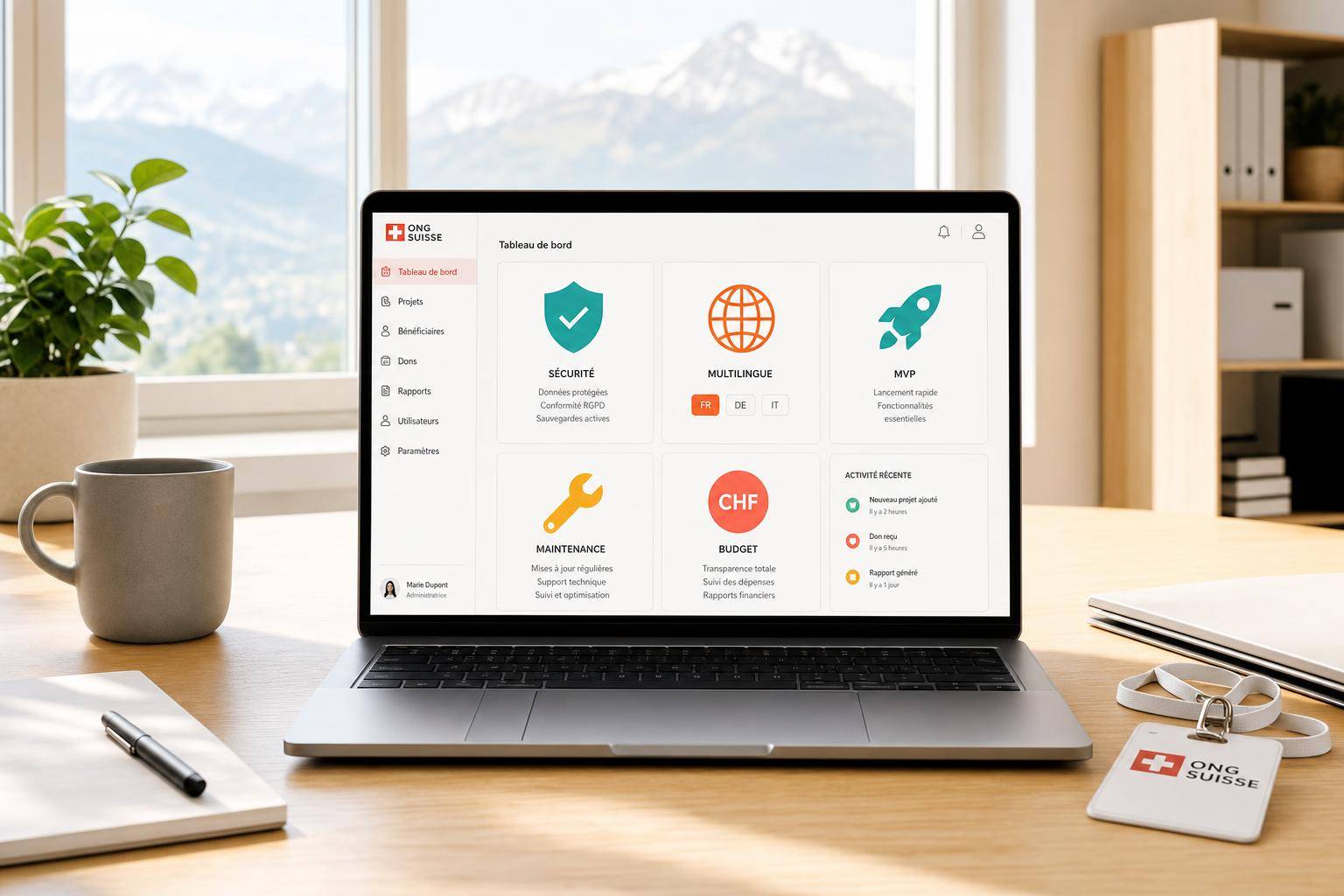
Development of web applications for NGOs
Web Application Development for NGOs
If I had to summarize in one sentence: an NGO should consider developing a custom web application when a simple website is no longer sufficient to manage donations, volunteers, beneficiaries, and reporting securely.
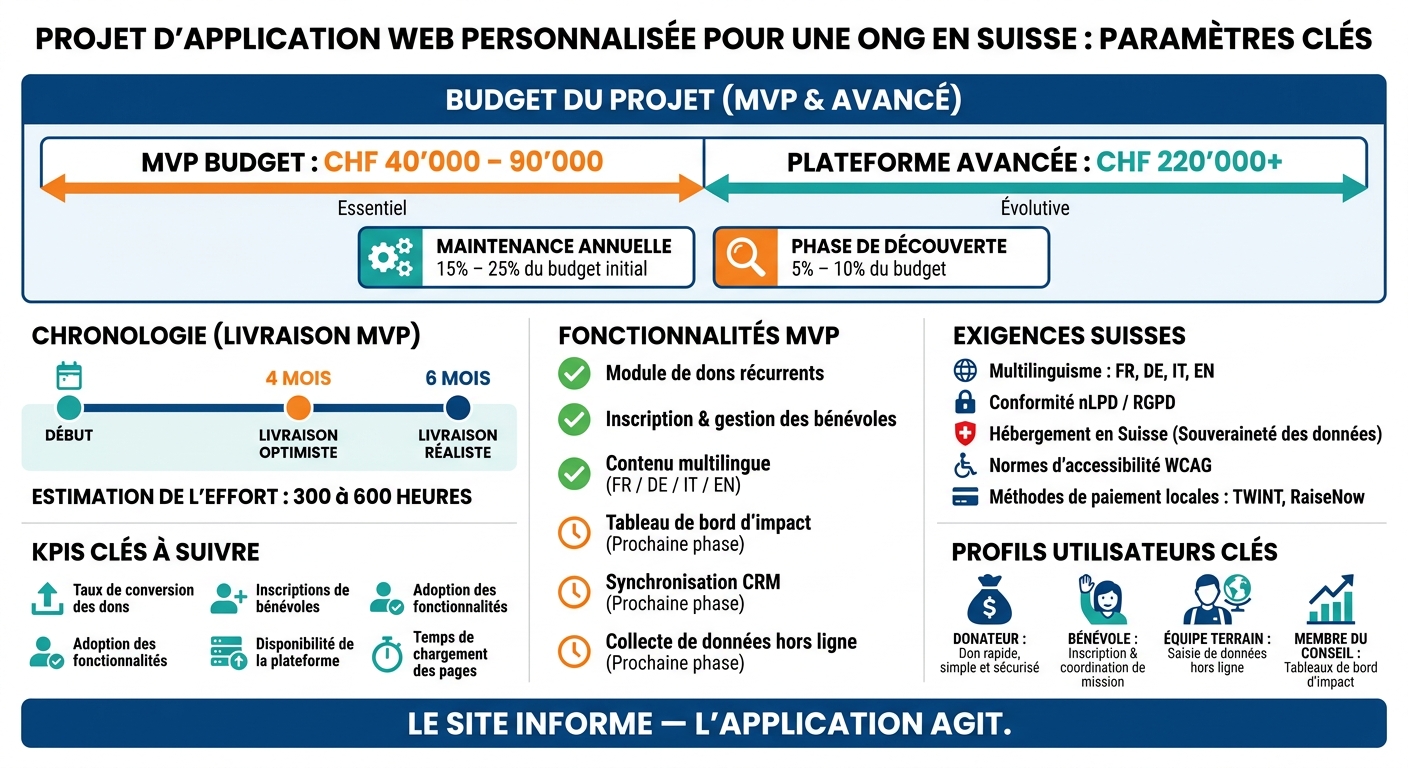
I highlight 4 key points from the guide: clearly define the need, launch an MVP first, consider security and compliance from the start, and allocate a budget for maintenance. In French-speaking Switzerland, this also means considering multilingualism from the start, nLPD/GDPR, hosting in Switzerland, and payment methods like TWINT.
In essence, if I am preparing for this type of project, I need to validate:
- who uses the tool: donors, volunteers, teams, beneficiaries
- what to launch first: donations, volunteers, multilingual content
- how much to invest: often CHF 40,000 to 90,000 for an MVP, then more depending on the scope
- how much time to plan: often 4 to 6 months
- what to protect: sensitive data, access, payments, availability
- what to monitor after launch: donation conversion, usage, availability, loading time
Here is the most useful point to keep in mind: the website informs, the application acts. It processes data, manages access rights, and automates tasks. For an NGO, this is often where time savings and error reduction come into play.
| Subject | What I remember |
|---|---|
| Initial need | Go beyond a showcase website |
| Priority | Launch an MVP with basic functions |
| MVP budget | CHF 40,000 to 90,000 |
| Larger project | Can exceed CHF 220,000 |
| Indicative timeframe | 4 to 6 months |
| Swiss constraints | FR/DE/IT/EN, nLPD/GDPR, local hosting |
| Maintenance | Often 15% to 25% of the initial budget |
So, I see this article as a simple plan: start from the uses, limit the initial scope, choose a technical base that stands the test of time, then launch with tests, training, and follow-up.
Budget & Deadlines for an NGO Web Application in Switzerland
Defining the Needs, Users, and Project Scope
Before writing a single line of code, an NGO must answer three simple questions: who uses the application, what for, and with what constraints. This framing work transforms usage needs into concrete project choices. It generally represents 5 to 10% of the budget and can prevent costly redesigns [7].
Identifying Users and Journeys
Each group of users expects different things.
A donor wants a simple, readable, and transparent journey. A volunteer is mainly looking to sign up for missions and coordinate them smoothly. A field worker should be able to enter data, even without an internet connection. And a board member expects clear dashboards for reporting and impact monitoring.
For each profile, a few basic points need to be documented:
- entry point into the application
- tasks to be completed
- useful data
- validation steps
- current obstacles
This is often where the problem lies. Obstacles lead to scattered data, slow reporting, or even manually entered tax receipts [2]. In general, this framing is built in UX workshops, with personas and journey mockups, before any technical choices [4].
At this stage, a triage is necessary: not everything is equally important.
Prioritizing Features: MVP First, Rest Later
Once the needs are established, choices must be made. Putting all ideas into the first version is neither possible nor desirable. The goal of an MVP (Minimum Viable Product) is to launch the most critical functions first, then progress based on user feedback [2][6].
| Functional Block | MVP Priority | Next Phase |
|---|---|---|
| Recurring donation module | ✓ | - |
| Volunteer registration and management | ✓ | - |
| Impact dashboard | - | ✓ |
| CRM synchronization | As needed | ✓ |
| Offline data collection | As needed | ✓ |
| Multilingual content | ✓ | - |
This approach helps to stay within a range of CHF 40,000 to 90,000 for an MVP. Then, the scope can expand in stages. A more advanced platform can exceed CHF 220,000 [7].
Aligning Scope with Governance and Available Budget
In an NGO, technical choices are not made in a corner between two people. The board of directors validates financial commitments. Program teams set field priorities. And institutional partners may require very specific reporting formats. Involving them in the discussion from the framing stage avoids many bottlenecks later on.
Concretely, this means aligning delivery milestones with annual budget cycles in CHF, clearly specifying responsibilities - who approves what, and within what timeframe - then progressing through successive deliveries rather than with a single major production release.
The next steps involve defining the architecture, UX, and integrations.
sbb-itb-454261f
Designing the Architecture, UX, and Technical Foundations
Once the scope is set, architecture and UX play a direct role in adoption. The idea is simple: move towards simplicity, maintain a single source of data, and prepare for the future without burdening the MVP. The architecture should serve the initial product while leaving room for subsequent phases. In practice, a single data source should feed donations, volunteers, beneficiaries, and reporting to avoid duplicates and discrepancies between modules [2][8].
Building Clear UX for Donors, Volunteers, and Teams
Donors, volunteers, beneficiaries, and internal teams do not use the application in the same way. Each screen should therefore cater to a specific journey: making a donation, signing up for an activity, following an action in the field, or consulting reporting data.
For donors, the journey should be short, simple, and secure. They should be able to donate quickly, with local payment methods like TWINT or RaiseNow [6][3]. For volunteers, the expectations are more concrete: an integrated calendar, event registration, and automatic reminders [3][2]. Beneficiaries need a portal to track services, consult documents, or submit field data [5][2]. Internal teams benefit from a centralized dashboard to manage donation history, volunteer schedules, and impact reporting [2][8].
An outdated or poorly designed interface quickly hinders usage. Mobile-first is crucial, especially for spontaneous donations and field teams, who often work with limited connectivity [4][5]. In such contexts, offline data entry with deferred sending upon network return makes a real difference [2][5].
Accessibility should also be planned from the start. Compliance with WCAG, high contrast, keyboard navigation, and compatibility with screen readers are key points for inclusion. In Switzerland, these elements are often required for public funding purposes [6][3].
Multilingualism should not be an afterthought. If the application targets national use, French, German, and Italian should be planned from the content structure stage [5][3].
Once the journeys are validated, these usages directly guide the technical choices and integrations to be addressed first.
Choosing Architecture, Stack, and Integrations
The technical choice depends on the level of functional complexity. For an application with specific business needs - managing recurring donations, tracking beneficiaries, or impact reporting - frameworks like Laravel, Symfony, or Next.js offer a flexible base to build and evolve the platform [2]