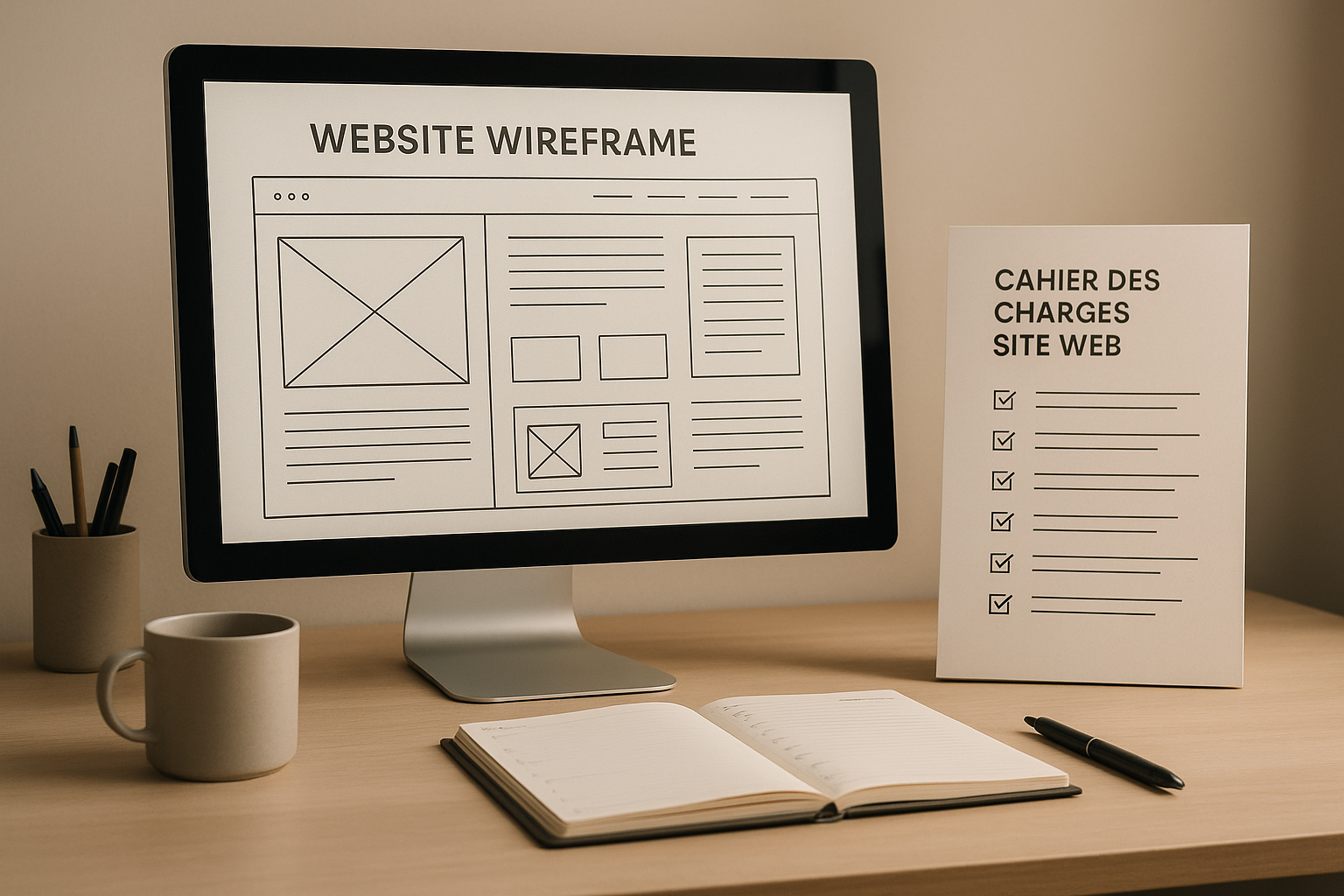
Specifications website : complete template 2026
Website specifications document: complete template 2026
A web specifications document is your detailed plan to define the needs, objectives, and technical specifications of a website. This document is essential to avoid misunderstandings, stay within budgets, and ensure that your project meets user expectations. For 2026, here's what should be included:
- Clear objectives: Determine what you want to achieve (e.g., increase conversions by 25% by mid-2026).
- Target audience: Describe users (languages, online behaviors, specific expectations).
- Technical requirements: Multilingual CMS, enhanced security (SSL/TLS, backups), performance (loading time < 3 sec).
- UX/UI design: Responsive, intuitive navigation, WCAG compliance (WCAG level AA minimum).
- URL structure: Optimized, multilingual, analytics tools (Google Analytics 4).
- Multilingualism: Clear structure (URL, subdomains), professional translation, content adaptation to Swiss specifics.
In Switzerland, a well-designed specifications document not only ensures a smooth project but also a high-performing website tailored to local needs. It is the foundation for success in 2026.
Key components of a web specifications document
Project objectives and target audience
Start by clearly defining what you want to achieve with your site and precisely identifying who your users are. This framework will guide all your decisions, whether it's about integrating features or the design to adopt. Set specific business goals: attract qualified leads, sell online, increase local visibility in Geneva, or inform a community. Each of these goals should be measurable and associated with specific performance indicators.
To understand your target audience well, go beyond simple demographic data. Describe their online behaviors, language preferences (French, German, English), browsing habits, and expectations. For example, a Geneva-based SME in B2B will have different needs than an NGO looking to recruit volunteers. Define detailed personas: age, profession, digital skills, devices used, and main motivations.
Add measurable indicators to track your progress (e.g., increase conversions by 25% by June 30, 2026, or reduce bounce rate within six months). These metrics will help you evaluate the project's success and adjust your strategy. Once your objectives are set, detail the technical solutions needed to achieve them.
Technical requirements
Translate your needs into clear specifications for developers here. For example, specify your expectations for hosting (ideally in Switzerland to comply with regulations) and set goals like a loading time of less than 3 seconds or availability of 99.9%.
Choose a CMS suitable for your multilingual needs, capable of efficiently managing French, German, Italian, and English, with separate URLs for each language. Decide whether you prefer an open-source or proprietary solution and determine the level of autonomy desired to manage content on a daily basis.
Security is essential, especially if your site handles sensitive data. Include protocols like SSL/TLS, two-factor authentication, daily automatic backups (kept for at least 30 days), and strict compliance with Swiss data protection standards. If your site needs to handle traffic spikes or continuous user growth, mention it in the specifications document.
For specific features, be detailed: contact forms with server-side validation, integration of payment systems in CHF (Twint, PostFinance, credit cards), member areas with access rights management, or API connections to integrate business tools.
UX/UI design specifications
Once the technical aspects are defined, focus on the design and user experience. Describe your design specifying the main and secondary colors (including hexadecimal codes), typography for titles and body text, as well as styles for buttons and recurring visual elements. If you already have a brand, provide the source files (vector logos, style guide).
Organize navigation by defining the structure of main and secondary menus, as well as the layout of content, including language management. A detailed site map is recommended, with all pages and their hierarchy. Also, indicate responsive breakpoints for smartphones (up to 767 pixels), tablets (768 to 1024 pixels), and computers (1025 pixels and above). Plan for adaptations like hamburger menus, automatically resized images, and simplified forms for touchscreens.
Accessibility should be a priority from the start. Aim for compliance with WCAG guidelines at level AA, ensuring sufficient contrast (minimum 4.5:1 for text), textual descriptions for images, keyboard navigation, and clear forms with explicit labels.
SEO and digital marketing requirements
To achieve your business goals, ensure optimal visibility on search engines from the design phase. Integrate a bilingual or multilingual keyword strategy tailored to the Swiss market, considering regional variations (e.g., "nettoyage" for French-speaking Switzerland and "Reinigung" for German-speaking Switzerland).
Define the technical aspects of SEO: optimized URL structure (short, descriptive, and including relevant keywords), customizable meta tags (title, description, Open Graph), Schema.org structured data, and generation of an XML sitemap. Also, mention needs in terms of loading speed, a key factor for SEO.
For content, plan a structure allowing regular publication of articles or news, with categorization options, tags, and social media sharing tools. If a content strategy is planned, include needs like an integrated editorial calendar and a validation process.
Finally, install Google Analytics 4 (or a privacy-respecting alternative compliant with Swiss standards), Google Search Console, and, if necessary, other tracking tools. Ensure that these integrations comply with user consent laws and data protection regulations.
Building a bilingual specifications document for Switzerland
Why bilingual content is essential in Switzerland
Switzerland stands out with its four national languages: French, German, Italian, and Romansh. This linguistic richness represents an opportunity but also a challenge for companies aiming to reach a broad audience. In French-speaking Switzerland, especially in Geneva, French dominates. However, English is increasingly becoming a working language, particularly in international sectors, NGOs, and organizations based in the region.
A site limited to a single language drastically reduces its reach. For example, targeting only French speakers automatically excludes German speakers, who represent about 62% of the Swiss population, as well as English-speaking expatriates and international companies. Conversely, a site only in English may seem distant to local SMEs or Swiss clients, who are often more comfortable in their native language.
Opting for a bilingual French-English site is often a strategic choice for Geneva-based companies. This allows addressing both the local market and international audiences while managing translation and maintenance costs. In some sectors, such as humanitarian aid, diplomacy, or technology, bilingualism becomes indispensable.
When drafting the specifications document, it is crucial to clearly define the linguistic organization of the site. This includes the available languages, their structuring (separate URLs, subdomains, or parameters), as well as fully or partially translated content. Also, consider adapting elements such as error messages, confirmations, automatic emails, and metadata for each language to ensure a consistent experience.
Beyond translation, it is necessary to consider cultural specificities. A simple word-for-word translation is not enough: examples, references, and local formats (such as dates or currencies) must be adapted. This attention to detail enhances the credibility of your site and improves the user experience for each linguistic group. These considerations require a rigorous approach in drafting the specifications document. Let's see how to implement this bilingual strategy in the document.
Writing in French and English
When dealing with a bilingual specifications document, it is essential to ensure perfect consistency between the language versions. The first step is to choose a main language in which the document will be written first and which will serve as a reference. For a company based in Geneva, French is often preferred, but some international organizations may opt for English.
To facilitate future translations, structure the document clearly with explicit headings and concise sentences. Avoid complex formulations or idiomatic expressions that are difficult to translate. For example, instead of writing "The site must have punch," opt for a more precise formulation like "The site must capture visitors' attention within the first 3 seconds."
To ensure uniform terminology, create a bilingual glossary containing key terms used in the document. For example: CMS (content management system), responsive design, SEO (search engine optimization). This glossary will be a valuable resource for developers and translators involved in the project.
Pay attention to style and convention differences between languages. For example, in English, "user-friendly" translates to "easy to use" or "intuitive," not "user-friendly." Similarly, design expectations may vary: English speakers often prefer clean and direct interfaces, while French speakers may appreciate more detailed explanations.
When describing your personas and target audiences, adapt them for each language. A French-speaking persona based in Geneva will have different behaviors than an English-speaking expatriate persona or an international client consulting your site from London. Specify in the specifications document if certain features or content will be specific to a language, for example: a local news blog in French or international case studies in English.
For site navigation and architecture, carefully plan the language switch system. Decide on the language selector's location (often in the top right corner), URL structure (e.g., ewm.swiss/fr/ and ewm.swiss/en/), remembering language preferences, and behavior when changing languages. If the site includes forms, also define how to handle multilingual submissions and their moderation.
Allocate a specific budget for professional translations and revisions tailored to cultural contexts. This will ensure not only the quality of the content but also its relevance to each target audience.
[WEBINAR] - How to write a specifications document for a successful website redesign? – Jan 2025
sbb-itb-454261f
Adapting your specifications document to current web standards
Once your needs are defined, it is essential to structure your specifications document considering the current web standards. Technologies evolve rapidly, and a document designed for 2026 must integrate these advancements to ensure the performance and sustainability of your project. This means going beyond basic features and including elements like artificial intelligence, accessibility, and mobile optimization.
Integrating AI and automation features
Artificial intelligence now plays a key role in web projects, even for SMEs or NGOs in Switzerland. In 2026, it is no longer a luxury reserved for large companies but an accessible tool that can transform the user experience while lightening your team's workload.
In your specifications document, include specific AI features. For example, an intelligent chatbot can answer frequently asked questions in multiple languages, 24/7, allowing your team to focus on more complex tasks. Unlike old chatbot models based on rigid scripts, modern solutions can learn and adapt.
AI can also personalize content based on user behaviors, location, or language preferences. For multilingual sites, it facilitates assisted automatic translation, although human revision remains essential for strategic content. Tasks like writing product descriptions or managing user-generated content can be efficiently automated.
In terms of SEO, AI can analyze your texts, suggest improvements, and generate suitable metadata. Additionally, it automates repetitive tasks like comment moderation or sending follow-up emails. However, it is crucial to set clear limits in your specifications document, such as human validation of generated content or transferring to a human operator when needed with a chatbot.
Respecting accessibility standards
Accessibility is an essential pillar, especially in Switzerland, where the Disability Equality Act imposes strict requirements for public websites. This trend is starting to extend to the private sector, making compliance even more crucial.
In your specifications document, specify the WCAG compliance level to achieve. Level AA is recommended for most professional sites as it ensures accessibility to a wide audience. The more demanding level AAA is for organizations wishing to go further in their inclusive approach.
Accessibility concerns all aspects of your site: images with alternative descriptions, subtitled videos, clear forms with explicit error messages, and interactive elements accessible via the keyboard. For multilingual sites, the lang attribute should be used to indicate the language of each section, and simplified language contents can be offered when relevant.
Also, budget for regular testing and audits. These checks will help maintain compliance during updates and ensure an inclusive experience for all your users.
Prioritizing mobile-first design and performance
With the majority of users browsing from their smartphones in 2026, adopting a mobile-first approach is a priority. This involves designing first for small screens before adapting the design to larger formats.
Your specifications document should emphasize a specifically designed mobile interface, not just a simple adaptation of the desktop version. This includes a clear hierarchy of content, sufficiently large touch zones (44 × 44 pixels minimum, according to Apple and Google), and simplified user journeys. The more complex a mobile interaction, the higher the risk of abandonment.
Finally, loading speed must be optimized. A smooth and fast experience is essential to capture and retain visitors' attention. These adjustments will ensure a pleasant navigation experience while allowing your site to evolve with technological advancements.
Conclusion
The benefits of a well-designed specifications document
A well-elaborated specifications document can make all the difference in the success of your web project. It establishes smooth communication among all stakeholders, eliminating misunderstandings and unforeseen costs. With this document, developers, designers, and marketing specialists share a common and clear vision of the objectives to achieve.
By defining your needs from the start, this document helps reduce financial risks and delays. Budgets are better respected, deadlines better controlled, and your team can focus on what really matters: adding value rather than managing unexpected issues.
A detailed specifications document is also an essential tool to ensure that your website meets the real expectations of your users. By documenting your target audience, their behaviors, and expectations, you lay the groundwork for an optimized user experience. This structured approach promotes the achievement of your goals, whether it's increasing conversions or reducing bounce rates.
Finally, this document becomes a constant reference throughout the project. It allows you to measure progress and verify that each decision remains true to your initial vision. In short, it is a strategic tool that protects your investment while increasing your chances of success.
With these advantages in mind, it's time to take action and start structuring your specifications document.
How to start your specifications document
To begin, start by clearly identifying the problem your site needs to solve. Set SMART goals (Specific, Measurable, Achievable, Realistic, Time-bound). For example, you could aim for a 10% increase in monthly inquiries within the next three months or a 10% decrease by a specific date [1][2].
Next, analyze your target audience in detail. Who are your users? Define their demographic characteristics (age, location), their level of tech familiarity, their interests, and the obstacles they face. Also, identify the keywords they use to search for your services. This information will guide your design and content choices