
Voice search: optimize for Alexa, Siri, and Google Assistant
Voice Search: Optimizing for Alexa, Siri, and Google Assistant
In Switzerland, voice search is essential. With 37% of the population using assistants like Alexa, Siri, or Google Assistant, it is clear that these tools are transforming the way people interact with brands and services. Unlike traditional searches, voice search provides a single answer, making it a crucial lever to capture users' attention.
Key Points to Remember:
- Growing Adoption in Switzerland: The smart speaker market will reach 69.27 million USD by 2025, with an annual growth rate of 8.5%.
- Local Usage: 75% of users use it for local searches, such as finding nearby businesses or services.
- Linguistic Diversity: Switzerland requires a multilingual strategy (fr-CH, de-CH) to meet the needs of different regions.
Why It Matters for Businesses:
- Optimized Voice SEO: Assistants prioritize structured and conversational content.
- Precise Local Data: Swiss format for dates (12.12.2025), prices (CHF 49.90), and geographical information.
- Technical Performance: Fast and Core Web Vitals-compliant sites to ensure an immediate response to voice queries.
Tools and Strategies:
- Structured Data: Use Schema.org (FAQPage, LocalBusiness, etc.) to facilitate interpretation by assistants.
- Conversational Content: Write clear and natural responses to frequently asked questions.
- Local Optimization: Update Google Business profiles and ensure consistency in NAP information (name, address, phone).
In summary, voice search is redefining user expectations. For Swiss businesses, adapting to this trend is an essential opportunity to remain visible and relevant.
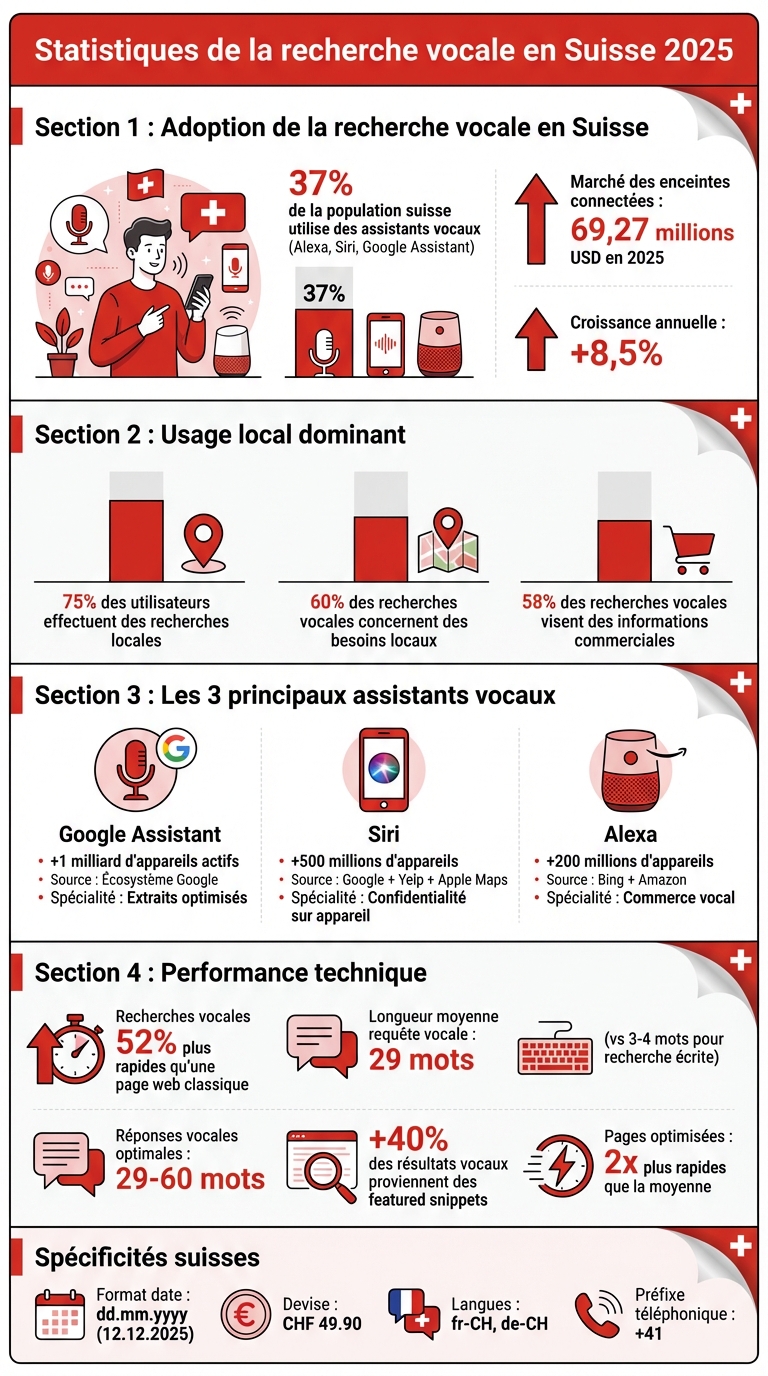
Voice Search Statistics Switzerland 2025: Adoption and Usage
How Voice Assistants Handle Queries
The Steps of Query Processing
When you ask a question to a voice assistant, a complex technical process is triggered within seconds. First, speech recognition converts your words into text. Then, natural language processing algorithms analyze this text to extract meaning and identify your intention. The assistant then searches for the most suitable answer in its databases and communicates it to you through a vocal response [2]. This process is incredibly fast: voice searches display on average 52% faster than a typical web page [4].
Unlike written searches, which typically consist of 3 to 4 words, voice queries are much longer, averaging around 29 words. This forces assistants to interpret complete and natural sentences [3]. Let's now see what sets the main voice assistants apart.
Differences Between Alexa, Siri, and Google Assistant
Each voice assistant has its own specificities, whether in terms of data sources or query processing methods.
- Google Assistant: It mainly relies on the Google ecosystem and favors featured snippets to provide quick and precise answers. With over a billion active devices worldwide, this assistant excels in managing complex voice commands and adopts a local approach to meet users' needs [4].
- Siri: This assistant uses Google for general searches but also partners with services like Yelp and Apple Maps for specific queries. Present on over 500 million devices, Siri emphasizes processing a large portion of queries directly on the device to ensure privacy. In addition to vocal responses, results are often displayed on the screen [4].
- Alexa: Alexa stands out for using Bing for local searches and its close integration with the Amazon ecosystem. With over 200 million devices worldwide, it is particularly focused on voice commerce and offers personalized skills to enhance its use. This orientation makes it ideal for online shopping or managing a smart home [4].
These differences underscore the importance of adapting your content according to the specificities of each platform.
Adapting Content to Search Intent
Voice assistants mainly respond to three types of intents: local, transactional, and informational. Interestingly, around 60% of voice searches are related to local needs [4].
To effectively address these intents, your content should adopt a conversational tone and provide clear and direct answers. Assistants favor well-structured content capable of quickly answering common questions. For example, instead of targeting "restaurant Geneva," opt for a more natural formulation like "Where to find a good Italian restaurant near me?". This conversational approach increases the chances of your content being selected as the unique response by the voice assistant. This is particularly relevant for effectively addressing the Swiss audience, often bilingual, with diverse expectations.
Technical Requirements for Voice Search
Implementing Structured Data
Structured data is essential for voice assistants like Alexa, Siri, and Google Assistant to understand your content. By using the Schema.org vocabulary, you enable search engines to quickly and accurately interpret your pages. This standard facilitates communication between your site and artificial intelligence systems.
To encode this data, prioritize JSON-LD – a method that integrates easily without altering visible HTML. Among the most useful schemas for voice search are:
- FAQPage for frequently asked questions,
- HowTo for practical guides,
- LocalBusiness for local information,
- Product for product descriptions.
Currently, over 45 million web domains already use Schema.org tags, representing over 450 billion indexed objects [5]. These data provide a solid foundation to make your content relevant, but they must be accompanied by a .
Mobile Performance Requirements
Loading speed plays a key role in visibility on voice platforms. Voice assistants prefer fast sites because users expect immediate responses. Your site must be fully responsive, capable of adapting to all screen types, especially smartphones, which dominate voice searches.
To ensure optimal performance, focus on Core Web Vitals:
- LCP (Largest Contentful Paint): initial loading time,
- FID (First Input Delay): interactivity,
- CLS (Cumulative Layout Shift): visual stability.
A slow or visually unstable site risks being ignored, even if its content is relevant. Optimize your images, compress your files, and enable caching to speed up loading. These adjustments ensure that your structured data displays effectively, regardless of the device used.
Swiss Localization Standards
To meet Swiss user expectations, it is essential to adapt your content to local conventions. Voice assistants must be able to correctly interpret your information according to Swiss standards. Here are some points to consider:
- Use the date format dd.mm.yyyy (e.g., 12.12.2025),
- Display prices with the CHF symbol and a non-breaking space (CHF 49.90),
- Respect Swiss separators: a comma for decimals and a space for thousands.
Also include metric units and express temperatures in Celsius in your structured data. These adjustments ensure that voice assistants convey your information in a format familiar to Swiss users. Finally, for a bilingual audience, correctly configure your hreflang tags to distinguish Swiss French (fr-CH) and Swiss German (de-CH). These tags help voice assistants choose the appropriate linguistic version for each user.
Creating Content for Voice Search
Writing for Conversational Queries
Voice searches are characterized by their natural tone and length. Unlike typed keywords, users often formulate complete questions, such as "Where to find an open Italian restaurant in Lausanne now?" instead of just "Italian restaurant Lausanne." To make your content relevant, it must reflect this way of expression.
Adopt a direct language and complete sentences that immediately answer questions. For example, instead of writing "Hours: 09:00-18:00," prefer a formulation like "We are open from 9 a.m. to 6 p.m. from Monday to Friday." This type of writing facilitates textual extraction by voice assistants.
Voice searches are often phrased as questions [6][7], so anticipate typical beginnings like "How," "Where," "When," or "Why." Integrate these formats naturally into your titles and paragraphs to align with user expectations. This conversational approach makes your content more suitable for voice assistants.
Managing Bilingual Content
In Switzerland, a bilingual approach is essential to reach a diverse audience. Each linguistic version of your content must respect local subtleties. For example, Swiss French (fr-CH) differs from standard French, just as Swiss German (de-CH) has its own specificities.
Create separate pages for each language, with specific URLs and hreflang tags to clearly indicate the language and region. This structure allows voice assistants to offer the appropriate version based on the user's language. Avoid content duplications that could harm your SEO.
Also adapt local formats, such as dates, prices, or regional expressions, to enhance the relevance of your responses. Voice assistants favor content that respects users' linguistic and cultural conventions.
Optimizing for Local Search Intent
In addition to writing conversationally and bilingually, it is crucial to add local details to precisely address search intents. Voice queries often include specific geographical references, such as neighborhoods, streets, or landmarks. For example, mention concrete information like "5 minutes walk from Geneva Cornavin station." These specifics directly correspond to questions asked to voice assistants.
Ensure your business details are up to date and follow Swiss formats: detailed opening hours, complete address, phone number with the country code (+41). Also include cantonal holidays and exceptional closures to address searches like "open today" or "Sunday hours."
Enrich your metadata with practical information such as accepted payment methods, accessibility, languages spoken, or parking availability. These details answer secondary questions that users frequently ask after an initial search. The more precise and comprehensive your content, the more it will be highlighted by voice assistants for local queries.
sbb-itb-454261f
Local Search Optimization for Swiss Markets
Maximizing Visibility in Local Searches
A well-filled profile is essential to appear in local voice searches. Include essential information such as your products, services, hours, rates, location, and photos. This data, regularly updated, is directly used by voice assistants to answer questions like "Which store is open near me?"[8]. A complete profile not only enhances your local visibility but also facilitates the integration of structured content, ideal for voice reading.
It is equally crucial to ensure the consistency of your NAP information (name, address, phone) across all online directories. Use a standardized format, such as the +41 prefix for Swiss numbers. To establish your local authority, actively engage in the community, obtain backlinks from local media, and optimize your "About" and "Contact" pages by adding precise geographical details[8].
Structuring Content for Voice Reading
Once your local presence is consolidated, adapt your content to be easily read aloud by voice assistants. Prioritize short, simple sentences and direct answers. To maximize your chances of being selected as a voice response, limit your introductions to 29-60 words[8]. Use clear formats like lists, tables, or FAQs, taking into account the linguistic and cultural specificities of your audience