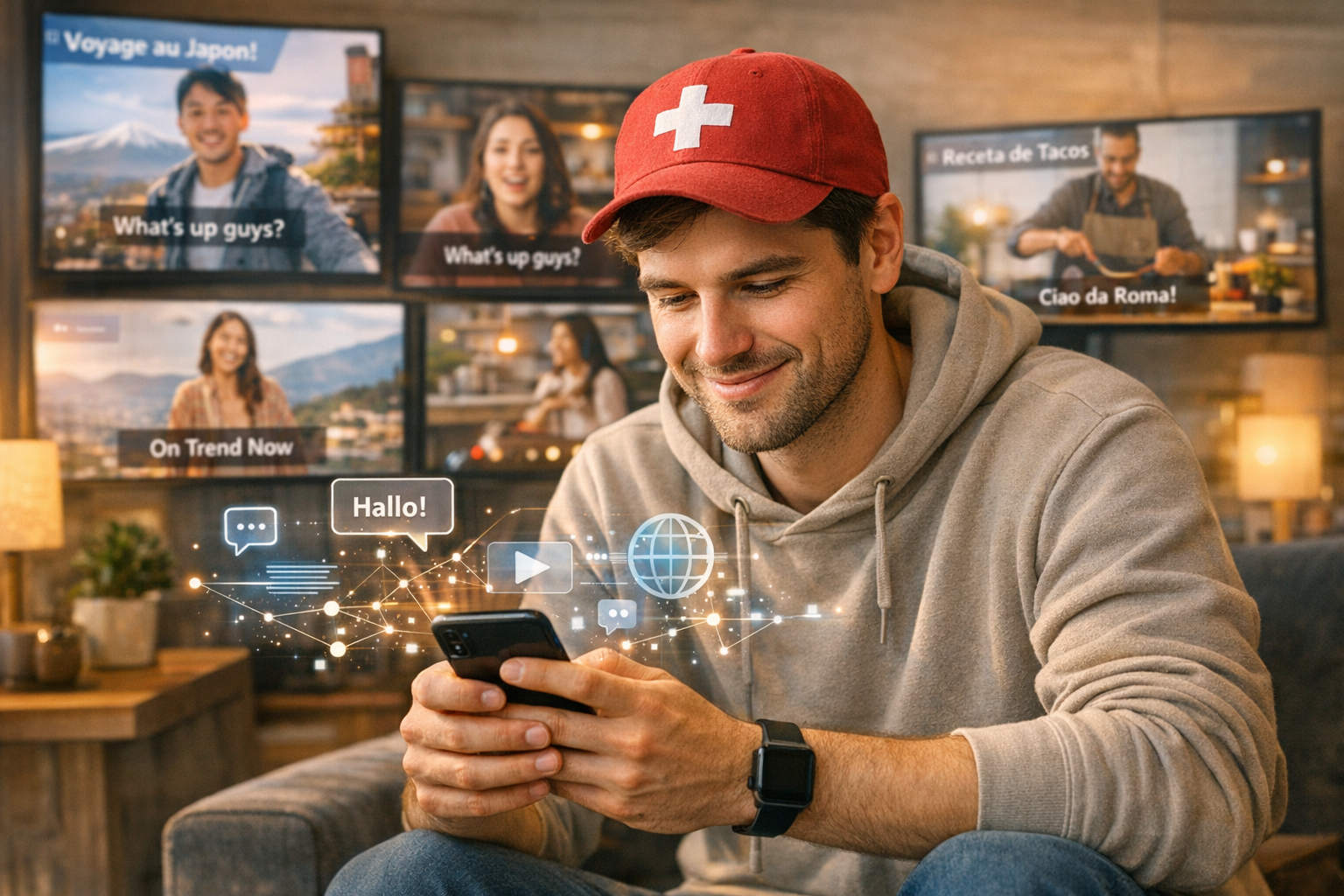
Storytelling digital: trends 2026
Digital Storytelling: Trends 2026
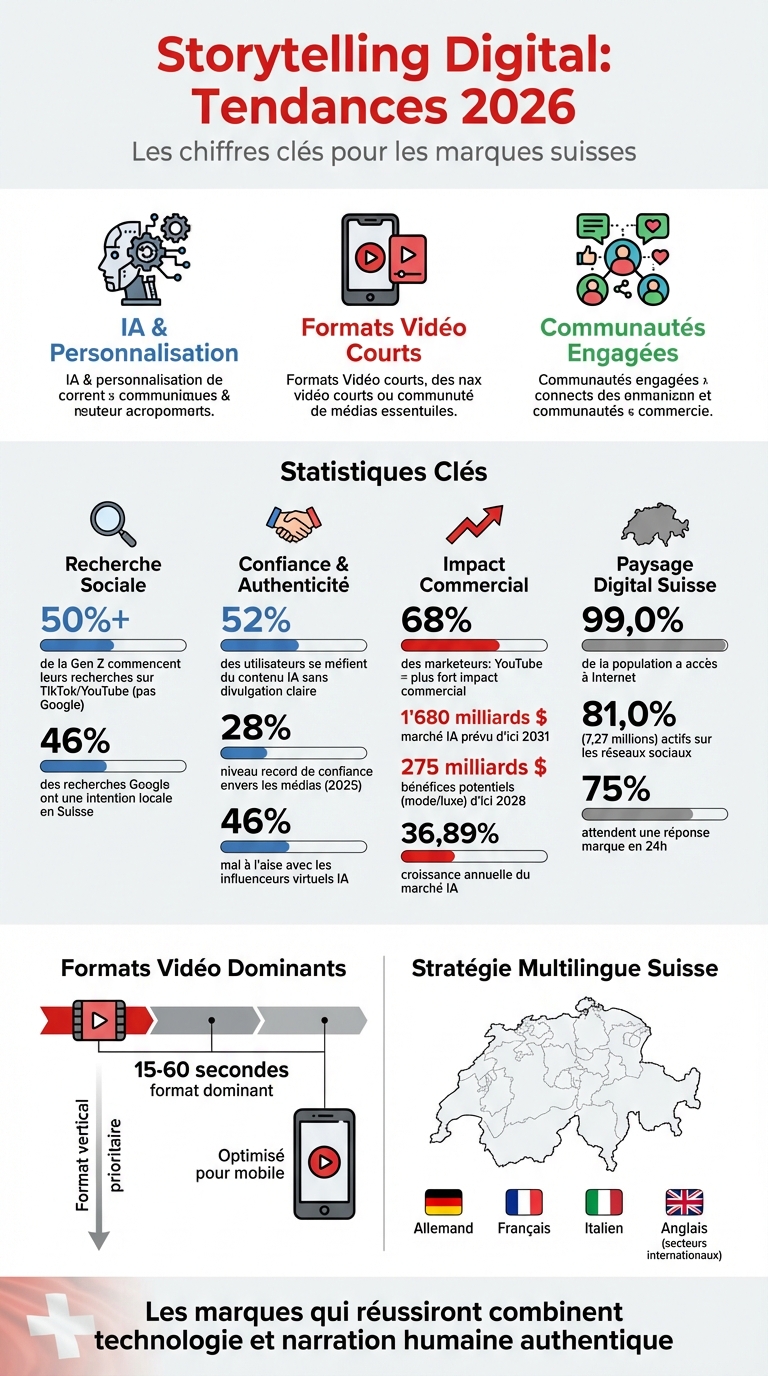
Digital storytelling in 2026 is based on three pillars: AI for personalizing narratives, short and immersive video formats, and building engaged communities. In Switzerland, where consumers prefer local and multilingual experiences, brands must adapt to platforms like TikTok and YouTube, which have become search engines for over 50% of Generation Z.
Key points to remember:
- AI and personalization: Real-time adjusted content for each user, integrating text, video, and audio.
- Short video formats: 15-60 second videos dominate, optimized for vertical format and social media searches.
- Trust and transparency: 52% of users are wary of AI content without clear disclosure; human touch remains central.
- Local strategies: Content tailored to the three national languages (German, French, Italian) and regional specificities.
Successful Swiss brands will know how to combine technology and human storytelling to meet the expectations of a demanding audience.
Digital Storytelling 2026: Statistics and Key Trends in Switzerland
Storytelling Trends That Will Change EVERYTHING in 2026
AI-Powered Personalization
Artificial intelligence is redefining storytelling personalization in 2026. Brands are no longer just segmenting their audiences; they are creating real-time tailored narratives to cater to each individual's unique preferences. This advancement relies on AI systems capable of managing the entire process, from initial strategy to continuous optimization [5][8].
Static interfaces are now a thing of the past, replaced by generative surfaces that adapt to the task, team, and precise moment [5]. In Switzerland, this translates into geographical and linguistic personalization: a user from Geneva, Zurich, or Ticino will see content tailored to their language and local context.
The global artificial intelligence market is expected to reach $1,680 billion by 2031, with an annual growth rate of 36.89% [8]. In sectors like fashion and luxury, particularly influential in Switzerland, generative AI could increase operating profits up to $275 billion by 2028 [7]. Let's see how this technology transforms content creation while partnering with human creativity.
Automated Content Creation with AI
AI is revolutionizing personalized content production by enabling the generation of tailored stories at scale. These tools can simultaneously integrate text, images, audio, and video, creating multimodal experiences that adapt to users' tone and expectations [8]. In Switzerland, this technology simplifies the creation of campaigns tailored to the three main national languages. Instead of developing three distinct versions, AI automatically generates relevant variants for each language region.
Local initiatives like Apertus in Zurich or Meditron at CHUV demonstrate this trend towards technological sovereignty, meeting Swiss requirements [4]. These solutions allow companies to keep their sensitive data on Swiss territory while offering stories tailored to their audiences.
AI allows the average person to simply imagine content and publish it. Without the need for equipment, editing skills, or staff, content will only require an excellent concept or idea to become reality.
This is how Jim Lin, social media director at Caterpillar, describes the democratic impact of AI [1]. This accessibility transforms content production but also raises concerns about quality and authenticity.
Finding the Balance Between AI and Human Creativity
Despite these advancements, a challenge persists: 52% of social media users are wary of brands that publish AI-generated content without transparency [1]. This underscores the importance of using AI to enhance efficiency while maintaining human authenticity, essential for building trust.
In 2025, global trust in media dropped to a record low of 28% [6], reinforcing the demand for authentic stories created by humans. As Tameka Bazile, associate director at Business Insider, explains:
Audiences can tell when something hasn't been created by a real person. They seek a human tone, a real experience, and the imperfections that make content relatable.
To address this challenge, many experts recommend the "Human-in-the-Loop" (HITL) model: AI is used to automate repetitive tasks and improve efficiency, while humans retain control over creative decisions and emotional expression [5][8]. For example, combines advanced digital solutions with a human-centered approach, letting creators guide storytelling and emotion while leveraging AI for tasks like data analysis or social media planning.
Kara Redman, CEO of Backroom, summarizes this dynamic well:
As AI-generated content increases, our desire for content that feels human will become more in demand. Relatability will be essential, so less polish and more real.
In the Swiss context, where consumers value transparency and authenticity [3], this balance between technology and humanity is not only essential but indispensable for maintaining long-term trust and engagement.
Short Videos and Immersive Formats
15 to 60-second videos now dominate digital storytelling. Platforms like TikTok, Instagram Reels, YouTube Shorts, and LinkedIn have adopted this format, creating an environment where 68% of marketers say YouTube generates the strongest business impact [1]. This trend redefines how Swiss brands tell their stories.
To succeed, it is essential to focus on episodic storytelling with recurring characters. Instead of aiming for instant virality, brands are adopting regular series. For example, in June 2025, GoPro partnered with influencer Susi Vidal (4 million TikTok followers) to produce a cooking video filmed with the HERO13 Black, showcasing the product's multiple uses [1].
In early 2026, Chipotle illustrated the impact of micro-creators by launching "The Lola Bowl," inspired by a custom order shared on TikTok by Lola Winters, a Gen Alpha creator. George Felix, CMO of Chili's, summarizes this approach:
Brands that present themselves with an authentic voice rooted in their identity will continue to succeed.
These developments pave the way for even more immersive and interactive formats.
Vertical Videos for Instant Engagement
The vertical format has become essential. Today, over 50% of Gen Z users start their searches on TikTok or YouTube rather than Google [1], turning social media into full-fledged search engines. This pushes brands to optimize their content for "Answer Engine Optimization" (AEO).
For Swiss businesses, this means producing videos that directly answer users' questions while considering local linguistic specificities. Successful storytelling combines a compelling start –