
Retargeting intelligent: recover 40% of lost visitors
Intelligent retargeting: recover 40% of lost visitors
Did you know that 90% of visitors leave your site without taking action? With retargeting, you can recover up to 40% of these lost prospects by targeting their specific needs at the right time. Here's how:
- Retargeting works through cookies to display personalized ads to users who have visited your site.
- In Switzerland, 75% of carts are abandoned, but well-designed campaigns can improve conversions by 70%.
- A bilingual approach (French/English) is essential to reach Swiss consumers, who prefer experiences tailored to their language and culture.
, based in Geneva, offers targeted and bilingual campaigns, taking into account local specificities such as displaying prices in CHF and respecting Swiss formats. With a clear strategy and tools like Google Ads or Meta Ads, you can turn these abandonments into concrete sales.
Key to success? Rigorous segmentation, tailored messages, and precise tracking of results. Are you ready to win back your lost visitors?
Why Swiss visitors leave your website
Main abandonment points in the customer journey
A large part of visitors leave a website at critical moments. For example, 96% of visitors are not ready to buy on their first visit [7]. One of the main reasons? Poorly adapted landing pages, where the content does not match the user's expectations or language. This often leads to immediate departure. Another common problem: overly complex forms that discourage users from the first click [6]. These behaviors reflect specific buying habits of Swiss internet users.
How Swiss users navigate and shop online
Swiss consumers have specific expectations that influence their navigation and purchasing decisions. In Geneva and throughout French-speaking Switzerland, offering a bilingual (French/English) option is essential to establish trust. With their high purchasing power, the Swiss attach great importance to price transparency. If amounts are not clearly displayed in CHF, this can reinforce the perception of Switzerland as an expensive destination, thus discouraging potential customers [5][4]. These specificities show how precise localization is essential.
Localization requirements for Swiss markets
Localization is not just about translating a website. It involves adopting Swiss standards for prices, dates, and digital formats. For example, prices must be displayed in CHF (CHF 149.90 and not CHF 149.90). Dates follow the format 31.12.2025, and time is written as 13:30. Regarding numbers, thousands are separated by an apostrophe (10'000), and decimals by a period (10'000.50). Not adhering to these conventions can harm credibility with local users. Another crucial point concerns data protection: clear management of cookie consent and compliance with the GDPR rules are essential to establish trust. Their absence can quickly lead visitors to leave the site [7]. By understanding these obstacles, you can better structure your and retain the attention of Swiss users.
Setting up your retargeting system
Installing tracking tools and managing consent
Before launching your campaign, it is essential to install tracking tools like Google Tag Manager or Meta Pixel. These tools allow you to collect data on visited pages, clicks, and actions taken by your visitors. However, in Switzerland and the EU, you must obtain explicit consent before activating these marketing trackers. To do this, integrate a clear and intuitive cookie management banner, allowing users to set their preferences. Without this step, not only your data may be incomplete, but you could also face non-compliance issues with the GDPR.
How to segment your audiences
Precise segmentation is key to personalizing your messages and maximizing the impact of your campaigns. Start by creating segments based on the level of engagement: for example, distinguish visitors who have only viewed one page from those who have added a product to the cart. Then segment by time criteria, such as visitors from the last 7 days compared to those from the last 30 days, to adjust the frequency of your ads. For the Swiss market, segmentation by language is also essential. Regularly analyze the search terms used in each language to refine your segments and better meet local expectations. These approaches will help you design campaigns truly tailored to each audience.
Creating distinct campaigns for French and English
Once your segments are defined, adapt your campaigns to the specificities of French and English-speaking audiences. This involves developing separate campaigns for each language, with visuals, texts, and landing pages tailored accordingly. Also, make sure to correctly configure hreflang tags on your site so that Google knows which language version to display to each user. For example, a click on a French ad should always redirect to a French page, not an English version. This linguistic consistency is essential to build user trust and reduce abandonment. For example, companies that neglect this localization lose 40% of their business opportunities [3]. At EWM SA, we structure our retargeting campaigns by creating separate branches for each language, ensuring that each audience receives a message in their original language.
The "sweet spot" retargeting (Meta Ads, Google Ads etc)
sbb-itb-454261f
Building retargeting funnels for FR/EN audiences
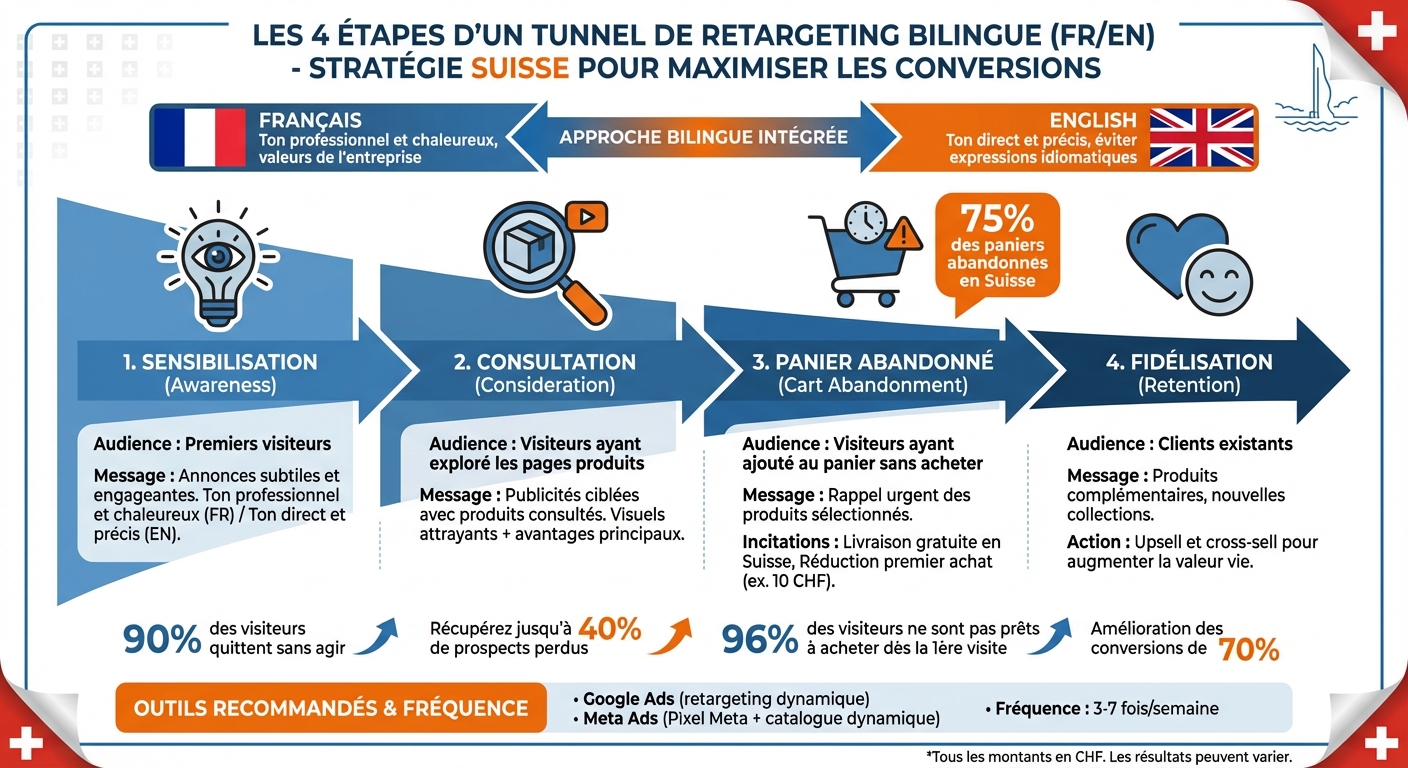
The 4 steps of an effective FR/EN retargeting funnel
The 4 steps of a retargeting funnel
An effective retargeting funnel is based on four essential segments: awareness, consideration, abandoned cart, and loyalty. For visitors discovering your site for the first time, focus on ads that highlight your values and offerings subtly and engagingly. For those who have explored your product pages, target them with ads displaying the items they viewed, accompanied by attractive visuals and key benefits.
Abandoned carts represent an opportunity not to be missed: remind these users of the products they selected, while offering incentives like free delivery in Switzerland or a discount on their first purchase. Finally, for your existing customers, focus on campaigns promoting complementary products or introducing your new collections. Once these segments are defined, tailor your messages to meet the expectations of different linguistic audiences.
Adapting messages for French and English users
For French-speaking users, especially in French-speaking Switzerland, prioritize a professional and warm tone. In a B2B context, formal language is appropriate, while for lifestyle products, a more informal tone can enhance closeness. French-speaking Swiss value quality and discretion, so your messages should inspire trust without being too aggressive [9].
For the English-speaking audience, often composed of expatriates and international professionals, opt for a direct and precise tone. Avoid idiomatic expressions that may lose clarity in translation. For example, a Swiss retail company saw a 40% increase in engagement after adjusting its campaigns to better reflect the cultural expectations of English speakers [2]. This linguistic approach is part of a localization strategy that demonstrates how much a tailored message can make a difference.
Using Google Ads and Meta Ads for dynamic retargeting
Once your messages are adapted, leverage dynamic retargeting to maximize the impact of your campaigns. These tools automatically show users the products they viewed.
On Google Ads, start by importing your catalog via the Google Merchant Center. Then set up dynamic Display campaigns targeting custom audiences by language. Remember to exclude users who have already made a purchase to avoid wasting your advertising budget.
On Meta Ads, Meta Pixel is your ally for creating audiences based on visited pages. Launch dynamic catalog campaigns by separating ad sets for French and English. Ensure each ad leads to an appropriate landing page with hreflang tags. Limit the display frequency to three to seven times per week to avoid fatiguing your audience [1].
Finally, let the machine learning algorithms of these platforms adjust your campaigns in real time. These tools analyze user behaviors to optimize your results [10]. By combining precise segmentation and powerful tools, you maximize your chances of converting each interaction into an opportunity.
Tracking results and improving performance
Which indicators to follow
To win back 40% of lost visitors, focus on four key metrics. First, the conversion rate, which measures the percentage of retargeted visitors completing a specific action, such as a purchase. Next, the cost per acquisition (CPA), expressed in CHF, indicates how much it costs to acquire a new customer through your retargeting campaigns. The return on ad spend (ROAS) evaluates the effectiveness of your investments: a 4:1 ROAS means that every franc invested generates CHF 4 in revenue. Finally, monitor the revenue generated by retargeting, essential data to assess the direct impact on your revenue.
On average, well-executed retargeting campaigns offer a 400% return on investment and can halve the cost per acquisition compared to other forms of [11]. In Switzerland, for bilingual campaigns, it is crucial to analyze these indicators separately for French and English-speaking audiences to better understand performance differences.
How to improve campaign results
Once this data is collected, focus on optimizing your campaigns to maximize effectiveness.
Here are some avenues to explore: adjust the display frequency of your ads based on engagement rates. Excessive exposure can annoy over half of consumers [14]. Test different frequencies for your French and English-speaking audiences to identify their respective tolerance thresholds. Simultaneously, conduct A/B tests on your bilingual messages by changing one element at a time, such as the title, visual, or call to action. Compare the results to identify specific language preferences and adjust your campaigns accordingly. Segmented campaigns can improve open rates by up to 44.9% [11].
Distribute your budget according to the performance of each segment. For example, if a campaign shows a higher ROAS, allocate more resources to it. Also, examine performance at each stage of the conversion funnel: cart abandonments, for example, often offer conversion opportunities far superior to simple product page visits.
Setting up tracking dashboards
To better track your performance, centralize all your data in a customized dashboard, such as Google Analytics 4. Segment your French and English-speaking audiences to analyze their conversion paths, identify abandonment points, and assess their engagement by language. Also, integrate your Google Ads and Meta Ads accounts to get an overall view of your campaigns throughout the conversion funnel.
On your advertising platforms, set up custom reports comparing the performance of campaigns in French and English. For prospecting campaigns, aim for a click-through rate (CTR) between 1% and 1.35%, while a CTR of 0.9% to 1.23% is considered satisfactory for retargeting [13]. Connect your CRM tools to track customer engagement throughout the funnel and precisely identify which campaigns generate the best long-term results [12]