
Redesign of SME website: when and why to plan it
Website Redesign for SMEs: When and Why to Plan It
Is your website over five years old? It may be time to rethink it. Why? Because an outdated site can harm your image and hinder your performance. With 64% of users browsing on mobile and high expectations in terms of speed (loading in less than 3 seconds), a modern site has become a key tool to remain competitive.
Key points to remember:
- When to redesign? Between March-June or September-October, to take advantage of quiet periods.
- Duration? 3 to 8 weeks depending on the extent of the changes.
- Warning signs:
- Dated design or site not optimized for mobile.
- Decrease in SEO results or unintuitive navigation.
- Gap between site content and your current objectives.
Benefits of a Redesign:
- Improved user experience (fast loading time, smooth navigation).
- SEO optimization (HTTPS, semantic markup, multilingual content for Switzerland).
- Preparation for future needs (mobile-first, compliance with GDPR).
Conclusion: A well-thought-out site can turn your visitors into customers. But beware, plan carefully to avoid mistakes like poor SEO management or lack of localization tailored to the Swiss market.
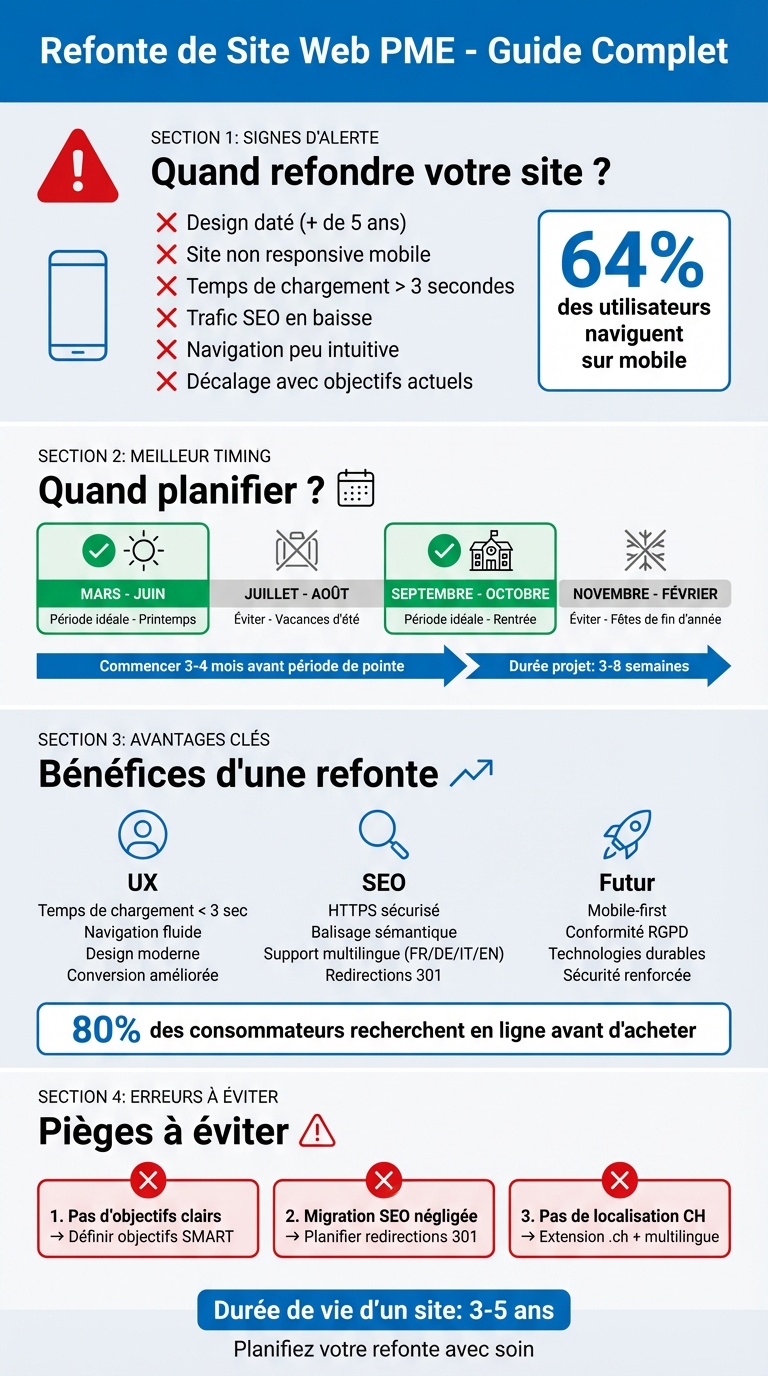
Checklist for SME website redesign: signs, timing, and key steps
SEO & Website Redesign: The Trap That Destroys Your Traffic (and How to Avoid It)
sbb-itb-454261f
When to Plan a Website Redesign
The timing chosen for a website redesign can directly influence its success. For SMEs in Switzerland, scheduling the redesign at the right time involves considering business cycles, peak demand periods, and realistic deadlines to successfully complete the project.
Best Times of the Year for a Redesign
The ideal periods to start a redesign are between September and October (after summer vacations) and March to June (in spring). These periods help avoid the constraints of year-end holidays and summer breaks, where team and partner availability may be limited. Working during these quieter times ensures better focus on the project and minimizes the risk of delays.
Time Needed for a Redesign
A typical redesign project usually takes between 3 and 8 weeks to go from design to development [1]. This timeframe depends on the extent of the changes: a simple visual update will be quicker than a complete redesign including the . To ensure your site is ready and functional before peak periods, it is advisable to start the project 3 to 4 months in advance. This time includes key steps such as the initial audit, design, development, content migration, and final testing.
Factors to Consider for Swiss Companies
Swiss SMEs must also take into account their annual budget cycles, often aligned with the fiscal year. In Geneva and Zurich, companies frequently plan their digital investments at the beginning of the fiscal year, making it easier to allocate the necessary resources. Regional specificities also play a role: Geneva-based companies operating internationally may aim for a launch before spring trade shows, while Zurich-based B2C businesses prefer to be ready before the key holiday season.
Signs It's Time to Redesign Your Website
Once you've decided it's time to , it's crucial to spot the warning signs that require quick action. These signs can indicate that your site is hindering your growth.
Outdated Design and Technology
A non-responsive site is not only penalized by Google, but it also limits access to over half of visitors who browse on mobile [1][2]. Additionally, outdated technologies like an old version of PHP, an unmaintained CMS, or the lack of HTTPS expose your site to security risks and reduce user trust [2][3].
A design older than five years gives an impression of a stagnant and uninnovative company [1][3].
Decrease in Traffic or Poor SEO Results
Excessively long loading times harm your SEO and discourage your visitors [1][2]. If your site displays a , unintuitive navigation, or lacks clear calls to action, it's a sign that your interface no longer meets modern user expectations [1][2].
Another indicator: if simple content updates require developer assistance, it shows that your backend is no longer suitable [2][3].
Misalignment with Your Business Objectives
Beyond technical and aesthetic aspects, it's important to check if your site aligns with your current strategy. If the displayed services no longer reflect your offerings or if you've launched new activities not featured on the site, it can confuse your prospects [4]. A decrease in the conversion rate can also indicate that your site no longer effectively meets your audience's expectations [1][4].
Lastly, if you can't integrate new features like an e-commerce space, a blog, or a member section, it reveals a too rigid architecture [5]. In a competitive market like Switzerland, especially in Geneva and Zurich, falling behind digitally can lead to missed opportunities.
“A website has a lifespan of 3 to 5 years and must adapt to technological advancements and design.” - Anthedesign [4]
Business Benefits of a Website Redesign
A website redesign is not just about aesthetics; it's a strategic approach to strengthen your online presence and boost your business performance. With an average lifespan of 3 to 5 years for a website [4], planning a redesign allows you to keep up with technological advancements and remain competitive in the Swiss market.
Some signs are unmistakable: outdated design, a decrease in traffic, loading times exceeding 3 seconds [1], or a site that no longer aligns with your objectives. Acting promptly on these signs helps you avoid missing important opportunities.
“It is better to opt for a continuous improvement process for a site to always perform well rather than opting for a complete redesign every 5 years.” [5]
To succeed, meticulous planning is essential. Set SMART goals, conduct thorough , and develop a detailed specifications document describing your technical needs, site structure, and essential features before starting. Ensure you manage SEO migration with 301 redirects to maintain your visibility and adapt your site to the multilingual needs of Switzerland to maximize your impact.
FAQs
What Budget to Plan for an SME Website Redesign in Switzerland?
The cost of a website redesign for an SME in Switzerland can vary significantly depending on several factors. Key factors include the project's complexity, desired features, and level of customization required.
Generally, it's wise to budget for aspects such as:
- Design: The site's design, reflecting your company's identity.
- Development: Technical creation of the site, including coding and specific integrations.
- Strategy: Consideration of usability and user experience to maximize site effectiveness.
- SEO (Search Engine Optimization): Optimization for search engines to ensure good online visibility.
- Security: Implementation of measures to protect the site and its users.
For a basic redesign, the budget starts at a few thousand Swiss francs. However, if your project requires advanced features or extensive customization, costs can easily reach tens of thousands of francs. It all depends on your goals and your company's specific needs.
How to Avoid a SEO Drop During a Redesign?
To prevent an SEO decline during a redesign, it's essential to follow some key steps. Start by defining specific goals to align your project with your SEO priorities. Ensure you retain essential SEO elements like meta tags, strategic keywords, and URL structure.
Another crucial point is managing 301 redirects. These redirects help preserve the authority of your existing URLs by correctly redirecting traffic to the new pages. Also, don't overlook optimizing technical performance, such as loading speed and mobile accessibility, as well as content quality.
After the launch, closely monitor your SEO indicators (like organic traffic or search engine rankings) to quickly detect any issues. Engaging an experienced agency, such as EWM, can help you manage this transition effectively while minimizing the risk of losing positioning.
Complete Redesign or Continuous Improvements: What to Choose?
It all depends on your company's specific needs and your site's current state.
- A complete redesign is necessary when your site is outdated, has technical issues, or no longer meets your goals, whether in SEO, user experience, or compatibility with modern devices.
- Continuous improvements, on the other hand, are perfect for gradual adjustments. This can include content or SEO optimizations, provided the site is still functional and generally meets your expectations.
Take the time to assess your site's condition, your short and long-term goals, as well as the available budget to guide your decision.