
Marketing writing with AI: guide for Swiss SMEs
Marketing writing with AI: guide for Swiss SMEs
Yes: a Swiss SME can publish faster with AI without losing control, if I set a simple framework from the start. In 2026, 71% of Swiss marketing teams use AI daily, and an article of 1,500 words can go from about 4 hours to 90 minutes.
If I want it to work, I have to do 5 things:
- choose my tools according to French, nLPD, and integrations
- with validated examples
- start from a FR-CH version, then create an adapted EN version
- keep human validation for facts, prices in CHF, and risky subjects
- track the results: time saved, volume published, emails, and cost per content
The key point: AI does not deliver the final text. It prepares a draft. My role remains to frame, correct, and validate.
Here is the most useful overview to remember:
| Subject | What I do |
|---|---|
| Tools | I choose Business or API versions, not public tools for sensitive data |
| Brand tone | I provide simple rules, 3 to 5 examples, and Swiss terms to respect |
| Bilingual FR/EN | I first write in FR-CH, then adapt in English without word-for-word translation |
| Quality control | I check facts, dates in DD.MM.YYYY, amounts in CHF, and sources |
| Compliance | I do not send customer, HR, or financial data to a public tool |
| Measurement | I compare before/after: time, cost, traffic, open rate, leads |
In short: I save time on production, then keep the human touch on judgment. It is this distribution that allows a SME from Geneva or Romandy to use AI without taking risks.
Choosing the right tools and building an effective content stack
Useful tool categories for marketing writing
Four families cover the essentials: LLM interfaces, office tools with AI, SEO assistants, and automation tools.
LLM interfaces like ChatGPT (GPT-4o), Claude, or Mistral are used to produce first drafts, summarize briefs, or suggest multiple titles. This is often where the work begins.
Office tools with AI like Microsoft Copilot and Google Gemini bring these functions into tools already used daily. No need to change your entire way of working.
SEO assistants like Surfer SEO or Semrush help structure articles around local queries. And automation tools like Make.com or Zapier connect everything from the generated draft to publication in the CMS or sending via email platform, without manual re-entry.
Ultimately, the choice is then based on three points: French, compliance, and integration.
How to evaluate these tools for a small Swiss team
For a Swiss SME, the selection is based on three criteria.
First, quality in French. Claude (Anthropic) and Mistral are appreciated for their good level in professional French [2].
Next, there is data processing. The free versions of ChatGPT or Claude use, by default, the entered data to train their models. For an SME, it is better to go through Business or API versions, check for a DPA compatible with nLPD, and avoid sending sensitive data without contractual guarantees [2].
Lastly, look at the compatibility with your CMS and CRM. A tool that does not integrate with your environment adds friction instead of removing it. Put simply: if your team has to copy-paste between five platforms, you quickly lose the promised time savings.
So measure the monthly cost, time saved, and integrations before making a decision.
| Tool Category | Main Use | FR/EN Support | Confidentiality Notes |
|---|---|---|---|
| LLM Interfaces (Claude, GPT-4o) | Writing, summaries, brainstorming | Excellent (FR/EN/DE/IT) | Prefer Business/API versions for nLPD |
| Sovereign Hosting (e.g., via Infomaniak) | Sensitive data, local hosting | Very good (Mistral/LLaMA models) | Data on Swiss servers (Geneva/Winterthur) |
| Office Tools with AI (Copilot, Gemini) | Emails, documents, summaries | Excellent | Integrated with Microsoft 365/Google enterprise agreements |
| SEO Assistants (Surfer SEO, Semrush) | Optimization, local keywords | Good | Data generally public; avoid personal data |
| Automation (Make.com, Zapier) | Writing connection → CMS/email | N/A (technical) | Check data flow encryption |
How the content stack integrates with the site, email, and reporting
Once the stack is chosen, the real focus shifts to moving from draft to publication. The idea is not to multiply tools but to create a simple flow: human strategy, AI draft, human validation, SEO optimization, then automatic publication [1][3].
Make.com or Zapier manage transitions from one step to the next. For example, a validated draft can be sent directly to WordPress or HubSpot. For SMEs working in FR/EN with a site, newsletters, and landing pages, integrating these flows into the CMS and CRM is key to reducing operational friction.
sbb-itb-454261f
How to grow your business with generative AI?
Defining the brand voice and building a bilingual FR/EN workflow
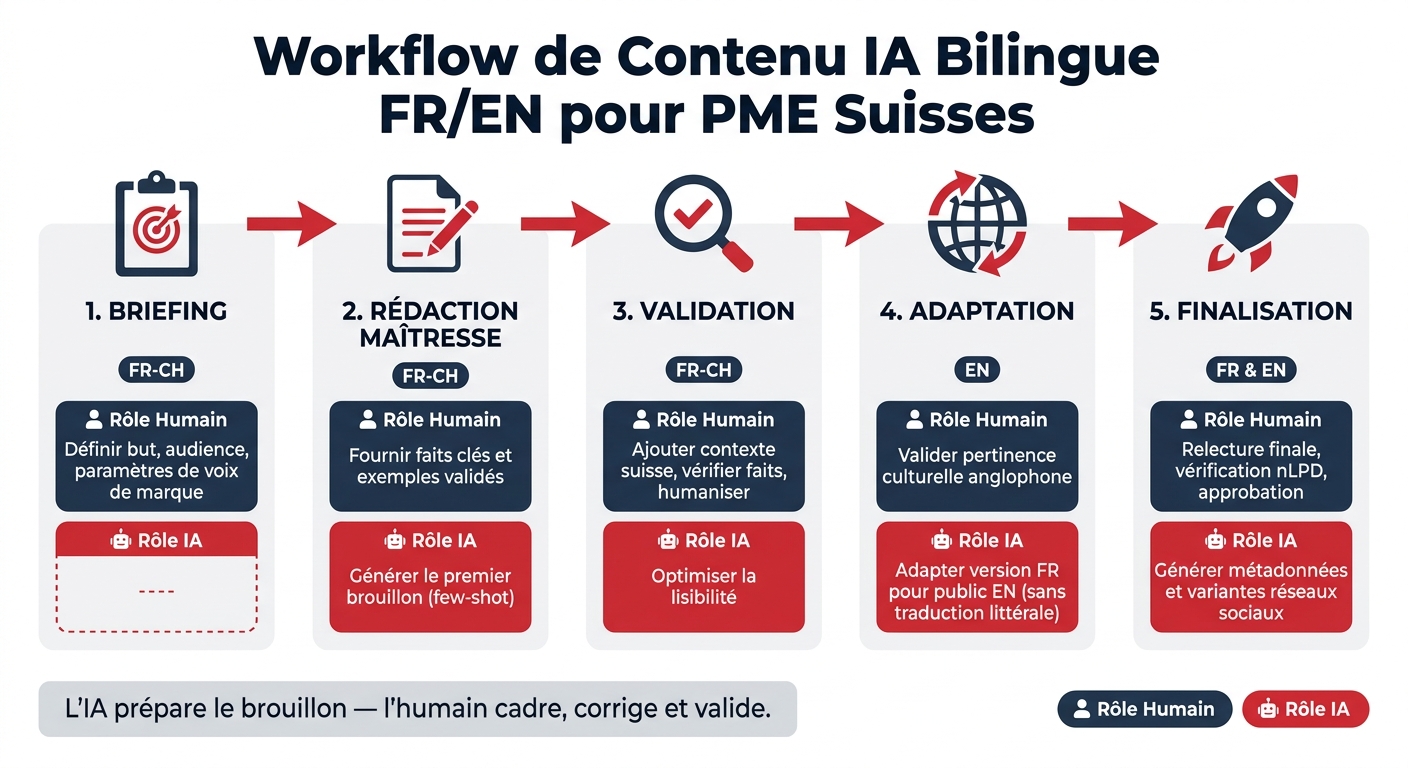
Workflow AI Content Marketing for Swiss SMEs: 5 Key Steps
Once your tool stack is in place, the real work begins: ensuring that AI writes like your brand, not like a generic SME. To achieve this, you need two things: a clear charter and a stable workflow. In short, tools are not enough. You also need to give them tone and language rules.
Writing a brand voice brief that AI can follow
AI does not read between the lines. It follows instructions. Without a reference document, it often produces correct but generic text. And that's exactly what you want to avoid.
This document, often called an AI editorial charter, should cover at least:
- brand personality: serious, accessible, expert
- level of formality:
vousortudepending on the context - targeted sentence length
- specific terms to use
- phrases to avoid
Also, include Swiss conventions: date format in DD.MM.YYYY like 29.06.2026, currency in CHF, common Swiss terms, and local references related to Geneva or Romandy [5].
The style guide can rely on 5 to 10 annotated excerpts. The prompt, on the other hand, only needs 3 to 5 validated examples. This is often where everything is decided: a few good examples are better than a long explanation.
Writing prompts that produce usable drafts
The charter alone is not enough. The prompt must turn these rules into clear instructions. A good prompt follows a fixed structure, which you can reuse from one campaign to another to maintain consistency [5].
- Context: who is the company, and who is the content for
- Style reference: link or excerpt from the AI editorial charter
- Examples: 3 to 5 validated contents as models (few-shot). Validated examples help AI adhere more quickly to the expected style.
- Specific objective: format, channel, length, mandatory facts
- Guardrails: prohibited statements, phrases to avoid, validation constraints
The idea is simple: the less room for ambiguity in the prompt, the more likely the draft is usable from the start.
Transitioning from the master French version to an English adaptation
The most effective workflow starts with a master French version, then moves to an English adaptation.
| Step | Human Role | AI Role | Language |
|---|---|---|---|
| 1. Briefing | Define the goal, audience, and brand voice parameters | - | FR-CH |
| 2. Master Writing | Provide key facts and validated examples | Generate the first draft from few-shot examples | FR-CH |
| 3. Validation | Add Swiss context, verify facts, and humanize the text with a | Optimize readability | FR-CH |
| 4. Adaptation | Validate cultural relevance for the English-speaking market | Adapt the FR version for the EN audience, without literal translation | EN |
| 5. Finalization | Final review, nLPD check, and approval | Generate metadata and social media variants | FR & EN |
The principle is clear: AI does not translate word for word. It adapts the message to the target audience. Then, a bilingual writer checks the English version before publication.
Setting up internal validation, quality control, and legal safeguards
Once the content is written and adapted, validation becomes the decisive step. After FR/EN writing, a final filter is needed to validate the substance, form, and level of risk.
Building an approval process with human validation
The basic idea is simple: the more a content can engage a company's responsibility, the tighter human control must be. A social media post can leave a lot of room for AI, with light editing. Conversely, a price list in CHF or a text with legal or financial implications requires much stricter validation by management or a legal expert.
The level of control changes according to the type of content and its risk level.
| Content Type | AI Role | Validator | Risk Level |
|---|---|---|---|
| Social Media Posts | High (writing and formatting) | Marketing Coordinator | Low |
| Product Descriptions | High (volume generation) | Product/Marketing Manager | Low |
| Blog Articles / SEO | Medium (structure and draft) | Content Editor / Subject Matter Expert | Medium |
| Newsletters / Emails | Medium (personalization) | Marketing Manager | Medium |
| CHF Pricing and Offers | Low (formatting) | Commercial Director | High |
| Legal / Financial / Medical Content | Low (research only) | Legal Counsel / Compliance / Management | High |