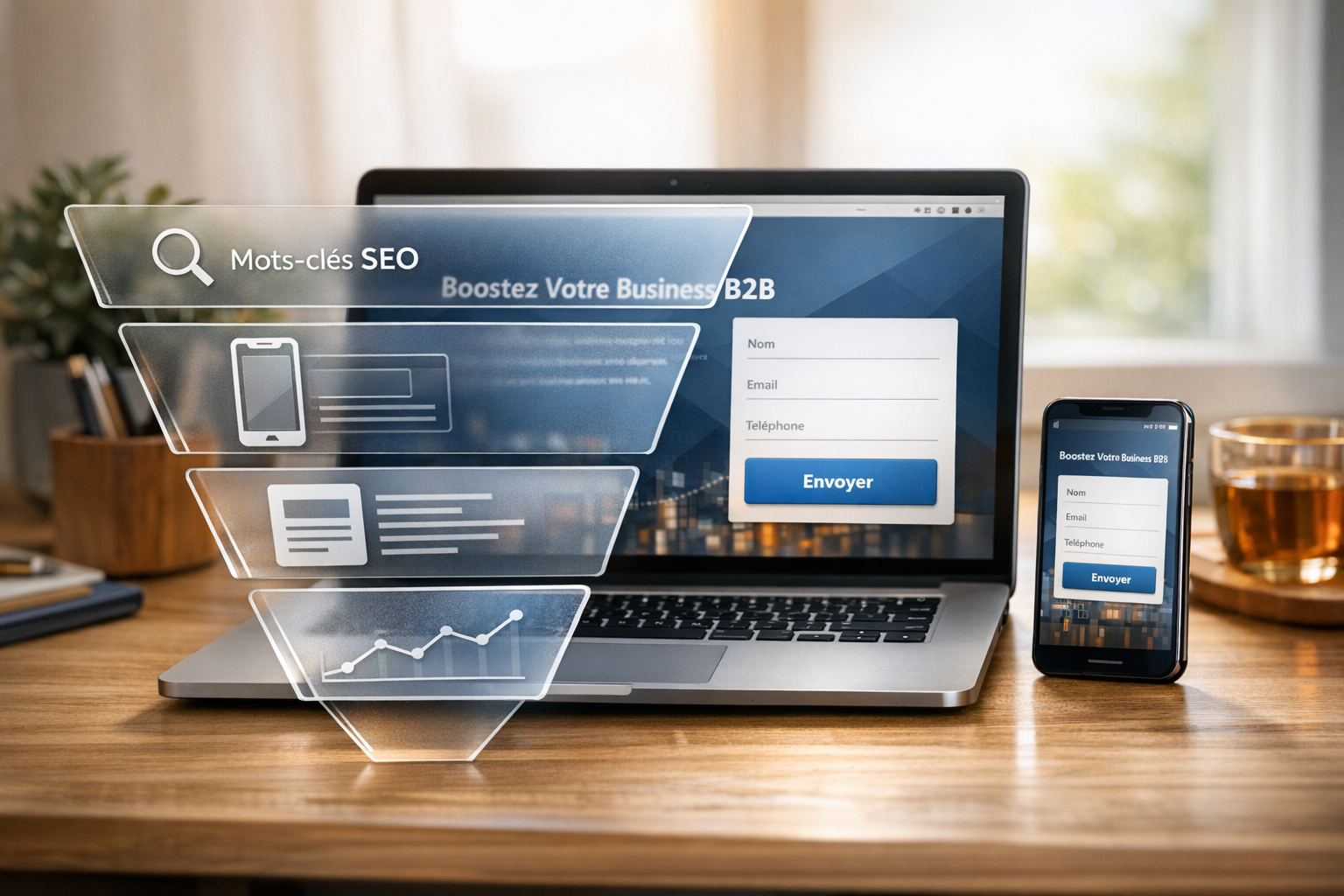
How to optimize a website for B2B leads
How to optimize a website for B2B leads
Your B2B website receives visitors, but few convert into qualified leads? Here are the keys to improve your results:
- Targeted SEO: Attract decision-makers with precise keywords and optimized tags. Examples: " " or "multilingual SEO optimization".
- : Simplify navigation, optimize for mobile, and reduce loading times. A fast site (1 second) can triple conversions.
- Relevant Content: Offer guides, case studies, and tools tailored to each stage of the buying journey.
- Effective Forms and CTAs: Limit fields, strategically place CTAs, and test different variants.
- Data Analysis: Track conversions, use heatmaps, and continuously adjust to maximize impact.
In summary: An optimized site combines SEO, UX, targeted content, effective CTAs, and continuous analysis to convert more visitors into leads.
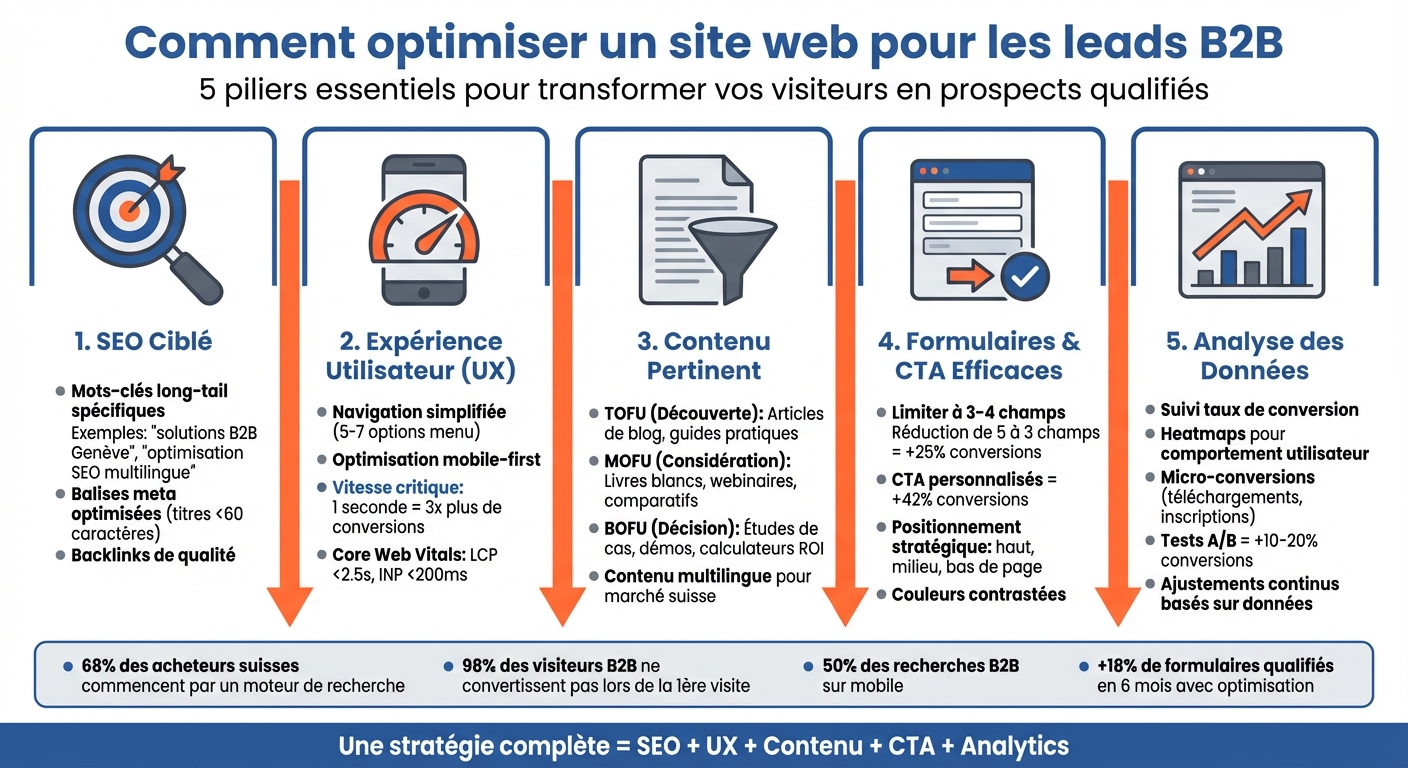
5 steps to optimize a B2B site and generate qualified leads
B2B Website Strategy To Drive Leads and Pipeline
sbb-itb-454261f
1. Use SEO to attract relevant B2B visitors
SEO for B2B aims to reach decision-makers looking for concrete solutions to optimize their operations, reduce costs, or improve efficiency. These buyers, engaged in often long buying cycles, require careful monitoring at each stage. A well-thought-out SEO strategy is based on these foundations before delving into specifics.
1.1 Search for keywords adapted to B2B buyers
In B2B, prioritize specific and detailed keywords, called long-tail keywords. For example, instead of targeting a generic term like "digital marketing," opt for phrases like "SEO optimization for multilingual B2B sites" or "lead generation solutions for industrial SMEs."
Tools like Ahrefs, SEMrush, or Moz Pro help identify keyword opportunities based on search volume, difficulty, and user intent. If you have a limited budget, Ubersuggest is a free alternative to analyze competition and discover relevant keywords [6]. Let's take the example of a Belgian SME specialized in ventilation: by using Ubersuggest to optimize its technical pages, it went from the second page of Google to the top 10, significantly increasing its quote requests [6].
Adapt your keywords to each stage of the buying journey. Start with informative terms like "how to improve B2B conversion" to attract visitors in the research phase, then target more transactional queries like "B2B SEO agency Geneva" to convert. In niche markets, also consider including product references or specific SKU numbers in your offers. Once your keywords are defined, optimize your tags to maximize their impact.
1.2 Optimize metadata, titles, and URLs
To turn your keywords into visibility, focus on your metadata and URL structure. Meta tags, visible on search engine results pages (SERP), play a crucial role. A good meta title should stay under 60 characters and naturally include the main keyword, for example: "SEO Services for Law Firms | B2B Expertise." The meta description, on the other hand, should be concise (150-160 characters) and emphasize clear benefits like savings or technical expertise.
H1 and H2 tags structure your content while reinforcing its SEO relevance. Integrate your keywords smoothly, without overdoing it. For URLs, opt for short and descriptive formats with hyphens, like "/optimize-website-leads-b2b" instead of a complex URL (e.g., "/page?id=123").
For multilingual sites, especially in Switzerland, hreflang tags are essential. They indicate to Google which language version to display based on the user's location. For example, use hreflang="fr-CH" for Swiss French and hreflang="de-CH" for German. A subdirectory structure (/fr/, /en/) is recommended to consolidate SEO authority under a single domain.
| URL Structure | Advantages | Disadvantages |
|---|---|---|
| Subdirectories (/fr/, /en/) | Easy to manage, maintains domain authority | Localized hosting not possible |
| Subdomains (e.g., fr.site.ch) | Clear separation of languages, localized hosting | Fragmented SEO authority |
| Distinct domains (.ch, .com) | Precise geographical targeting | High costs and complex management |
1.3 Build internal links and backlinks
A well-thought-out internal linking structure helps search engines and users navigate efficiently to your key pages. Organize your site around a pillar page, like a "B2B Lead Generation Guide," and link related content to it through descriptive internal links. This improves indexing, distributes SEO authority, and reduces orphaned pages. Regularly auditing your site can help identify and connect these isolated pages.
Backlinks, on the other hand, enhance your credibility with search engines. Instead of multiplying links from dubious sources, focus on partnerships with reputable sites in your industry. For example, MRS Digital positioned itself on the first page of Google for "law firm SEO services" by optimizing a page for specific keywords, thus attracting qualified traffic from law firms [3].
In Switzerland, prioritize partnerships with local professional associations, organizations, or specialized media to strengthen your relevance. A strong network of internal and external links enhances the credibility of your site, both for search engines and B2B decision-makers.
2. Improve user experience to convert more leads
If SEO attracts visitors, UX (user experience) plays a key role in retaining them and converting them into prospects. Attracting qualified B2B visitors is a first step, but it is equally crucial to guide them effectively towards conversion. A well-designed UX accompanies the visitor throughout their buying journey, making each step simple and intuitive. In the B2B sector, where buying decisions can be lengthy, smooth navigation and clear interface are essential to maintain interest and reduce abandonment.
2.1 Simplify navigation with clear paths
A well-structured navigation relies on an intuitive hierarchy and clear labels that match user intentions. For example, use explicit terms like "Solutions," "Resources," or "Contact," rather than ambiguous phrasing. Limit main menus to 5 to 7 options to avoid overwhelming visitors. If your site offers many subcategories (e.g., solutions by sector), mega-menus can visually and clearly organize these options without cluttering the interface.
Create dedicated landing pages for each stage of the buying journey. These pages should guide the visitor from initial information to final action, using strategically placed internal links. These links help users progress naturally without having to search for information themselves.
For multilingual sites, ensure that language versions are easily accessible via subdirectories like /fr/, /de/, or /en/. Once navigation is clarified, don't forget to optimize mobile display for a complete and consistent experience.
2.2 Optimize for mobile and speed
Clear navigation is effective only if it works perfectly on all devices. B2B decision-makers often use their smartphones for quick searches between meetings. If your site is not optimized for mobile, you risk losing visibility on Google and discouraging your visitors. Adopt a mobile-first approach: test your site on different formats to ensure buttons are accessible, forms are easy to fill out, and menus are intuitive.
To speed up your site, compress your images with tools like Imagify, enable caching through plugins like WP Rocket, and reduce unnecessary scripts. High-performance hosting and using a content delivery network (CDN) can also reduce loading times, especially for an international audience.
2.3 Use visual elements to guide visitors
Visual elements play a key role in directing visitors to your conversion goals. For example, contrasting call-to-action (CTA) buttons immediately attract attention: a blue "Request a Quote" button on a white background is hard to miss. Simple and intuitive icons (like an arrow for "Download the guide" or an envelope for "Contact Us") reinforce the clarity of proposed actions.
White space is equally important: it improves readability and highlights your CTAs and key messages. By visually isolating these elements, you naturally guide visitors' eyes to what matters most. Avoid overloading your pages with too many links or content blocks. Each page should have a specific goal, whether it's collecting an email address, offering a download, or encouraging contact.
For Swiss businesses, adapt local formats to enhance visitor trust. Display prices in CHF with the correct separator (e.g., CHF 2,500.50), use the DD.MM.YYYY date format (e.g., 16.02.2026), and prefer the 24-hour time format (e.g., 14:30). These small adjustments facilitate understanding and show that you consider local expectations.
3. Create content that meets B2B needs
In B2B, content plays a key role in guiding decision-makers throughout their buying journey. Unlike B2C, B2B purchasing decisions often involve multiple stakeholders, substantial budgets, and extended decision cycles. Targeted content can make a significant difference by precisely meeting buyers' expectations.
3.1 Develop content for each stage of the funnel
Each phase of the buying journey deserves tailored content. Here's how to structure your efforts:
- Discovery (TOFU): At this stage, prospects seek information. Offer blog articles or practical guides like "Reducing logistics costs in B2B" or "Optimizing HR processes in Switzerland."[4][7]
- Consideration (MOFU): Prospects evaluate their options. Offer them detailed resources like white papers, webinars, or comparative analyses. For example, a "Comparative Study of ERPs for Swiss SMEs" can help them weigh the pros and cons.[4][7]
- Decision (BOFU): Here, it's about convincing. Case studies, demonstrations, or ROI calculators are ideal to prove your concrete results. For example, show how your solution improved the ROI of a local company.[4][7]
Focus on in-depth and well-structured content. Include clear headings, logical sections, and calls to action to guide your prospects at each stage. Such an approach also facilitates adapting your content to local and international specificities.
3.2 Adapt content to Swiss and international markets
In Switzerland, a multilingual approach is essential. Searches are conducted in both French and English, requiring complete language versions to maximize your visibility. For example, target local queries like "SEO agency Geneva" with tailored content.[4][5]
To enhance your credibility, adhere to local conventions: use the CHF currency format (with an apostrophe), dates in DD.MM.YYYY format, and the metric system. Also, integrate relevant examples for the Swiss market, such as or the cantonal tax system.
For international reach, opt for a modular content approach. Address global issues like cost optimization while allowing regional adjustments via your CMS. This method ensures global consistency while remaining locally relevant.
3.3 Use case studies to establish credibility
Case studies are a powerful tool to demonstrate your expertise and results. Use a clear three-step structure: challenge, solution, results. For example, present a challenge like "increasing leads," detail your solution, then quantify the impact with specific numbers (e.g., "+30% leads for a Geneva-based company" or "40% ROI improvement").[4][7]
Add customer testimonials