IA in Swiss SMEs: marketing vs operations
AI in Swiss SMEs: marketing vs operations
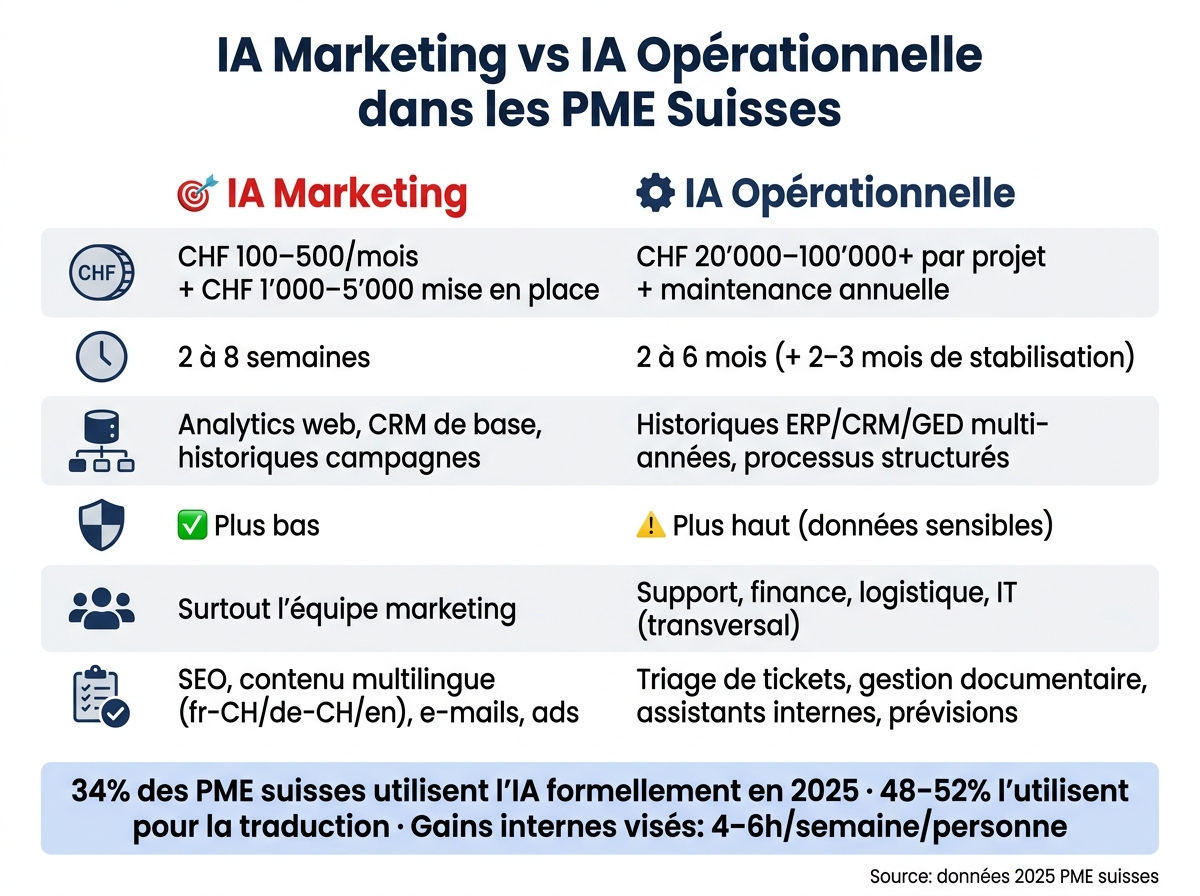
If I want a first test in 2 to 8 weeks with a budget starting from CHF 100 to CHF 500 per month, I often lean towards marketing.
If my real issue is internal workload, tickets, documents, or workflows, I look at operations, even though the project often takes 2 to 6 months and costs CHF 20,000 to CHF 100,000+.
In short, I can summarize the choice like this:
- Marketing: direct impact on the website, content, emails, and ads
- Operations: direct impact on documents, support, workflows, internal search, and forecasts
- Marketing: few initial data, simple test, impact mainly on the marketing team
- Operations: more sensitive data, heavier integrations, impact on multiple teams
- In Switzerland: multilingualism often pushes SMEs towards marketing first, while confidentiality more often hinders operations projects
I also note three figures that set the tone:
- 34% of Swiss SMEs already use AI formally by 2025
- 48 to 52% already use it for translation
- some internal cases aim for 4 to 6 hours saved per week per person in administrative tasks
So, the right starting point is not the same for everyone. If I lack leads, I test marketing. If my teams waste time on repetitive tasks, I test operations. In both cases, I assess the project based on simple measures: earned CHF, hours freed up, processing times, and .
AI Marketing vs Operational AI in Swiss SMEs
4 AI automations every SME should have in 2026!
sbb-itb-454261f
Quick comparison
| Criterion | Marketing AI | Operations AI |
|---|---|---|
| Purpose | Visibility, traffic, leads | Time saved, internal flows, support |
| Initial budget | CHF 100–500/month + setup | CHF 20,000–100,000+ per project |
| Data | Analytics, CRM, campaigns | ERP, CRM, EDM, tickets, procedures |
| Test period | 2 to 8 weeks | 2 to 6 months |
| Data risk | Lower | Higher |
| Teams affected | Mainly marketing | Support, finance, logistics, IT |
| Common cases in Switzerland | ticket sorting, documents, internal assistants, forecasts |
So, I go straight to the point: marketing to test quickly and cost-effectively, operations to address a real internal blockage with a heavier project.
AI marketing in a Swiss SME: rapid tests, direct impact on the site
For a Swiss SME, AI marketing is one of the use cases that can be tested without waiting for months. Here, we are talking about visible effects on the site quite quickly: more published content, better-structured pages, and smoother acquisition. However, AI does not primarily act on internal systems. At this stage, it mainly affects visibility and content.
Content, SEO, and landing pages in the fr-CH and multilingual context
Content is often the starting point. Articles, metadata, landing pages in French, German, and English: this is where AI can save time from the first trials.
Concretely, it helps to release initial versions faster, better organize page structure for SEO, and build a cleaner internal mesh. On the site, the effect is direct:
- more regular publication frequency
- broader semantic coverage
- more consistent tags
Human review remains the safeguard. It mainly serves to lock in tone, terminology, and brand consistency. In Switzerland, this point is crucial, especially when the same site needs to sound right in fr-CH, de-CH, and English.
Emails, ads, and site personalization
The use does not stop at content. AI marketing can also help with segmentation, lead scoring, creating ad variants, and customizing certain blocks on the site.
Here, it mainly relies on what already exists: CRM, analytics, campaign histories, and behavioral data collected with consent. Simply put, AI does not work miracles if the foundation is shaky. The main obstacle to personalization remains the quality of CRM data.
Comparative table: AI marketing uses according to cost, data, time, and team impact
Here are the simplest marketing uses to test.
| Use case | Cost | Data | Test | Site impact | Team effect |
|---|---|---|---|---|---|
| Content generation | Low | Little or none | Quick | Strong | Less writing, more reviewing |
| SEO optimization | Low to medium | Content + analytics | Quick | Strong | New validation flow |
| Email campaigns | Low to medium | CRM + histories | Quick | Medium | Key indicator tracking |
| Ads and variants | Low to medium | Campaign analytics | Quick | Medium | Less manual management |
These use cases launch quickly. The more operational aspects require more integration, more security, and more coordination between teams. At this level, AI mainly improves the site and acquisition. Operational gains come later, with a heavier implementation.
Operational AI in a Swiss SME: deeper gains, longer deployment
AI applied to operations plays in a different league. Here, we are not talking about the website or campaigns. We are talking about internal mechanisms, an area where AI can provide strategic expertise: document management, repetitive tasks, access to in-house procedures, and basic support. The gains can be deeper, but they generally require more time.
Process automation, document management, and access to internal knowledge
The most direct starting point often remains repetitive administrative tasks. A good example: classifying incoming emails. In many Swiss SMEs, this type of project aims for a reduction of 4 to 6 hours per week per administrative collaborator.
After document management, another use often yields results quite quickly: access to internal knowledge. A search assistant connected to internal procedures and guides helps a new collaborator find an answer in a few seconds, instead of exchanging messages or searching through multiple folders. An important point: this type of system can keep sensitive data within the company, without leaking data.
Support automation and operational forecasting
On the support side, the logic is quite similar. FAQ bots, ticket sorting, and automated responses in French, German, and English lighten the teams' workload and make responses more consistent. The effect is quickly seen in processing times, especially in SMEs active in multiple language markets.
When these basic uses are already in place, operational forecasting becomes the most ambitious project. Here, reliable data histories and deep integration with existing systems like ERP, CRM, or stock management tools are needed. Deployment often takes six months or more. In return, the effect on decision-making can be significant: fewer stockouts, less overstock, and better anticipation of activity peaks.[1]
Comparative table: Operational AI uses according to complexity, security, and organizational impact
| Use case | Complexity | Data quality | Security | Deployment time | Process impact | Team training |
|---|---|---|---|---|---|---|
| Flow automation | High | High (structured) | High (financial and personal data) | 4–6 months | Transformative | Significant |
| AI support (bots, sorting) | Medium | Medium (FAQ, logs) | Medium (customer data) | 2–3 months | Strong | Moderate |
| Operational forecasting | High | Very high (historical data) | Low (anonymized data) | 6 months and more | Strategic | Significant |
| Knowledge assistants | Medium | Medium (unstructured) | High (internal intellectual property) | 2–4 months | Moderate | Low to moderate |
In practice, operational AI often requires custom connectors between the AI model and the SME's systems. That's why a parallel test makes sense before launching a larger-scale AI deployment.[1]
Marketing AI vs Operational AI: costs, data, time, and team impact
Where budgets diverge: SaaS subscriptions vs custom integration
After the use cases, the most noticeable difference lies in implementation cost, data quality, and testing speed.
AI marketing often relies on monthly SaaS subscriptions. For an SME, the start can be with CHF 100 to CHF 500 per month, with CHF 1,000 to CHF 5,000 for setup if assistance is needed.[3][4]
Operational AI follows a different logic. As soon as it needs to connect to an ERP, CRM, EDM, or ticketing tool, it's no longer just a simple subscription. We are talking about projects between CHF 20,000 and CHF 100,000+, to which annual maintenance and hosting fees must be added.[5][6]
In short, on one side, you can test without much exposure. On the other, you need to prepare for a real project.
Data maturity, testing speed, and team impact
AI marketing can start with fairly simple data: web statistics, campaign data, and basic CRM are often enough to launch a first test. In practice, an SME can see the effect of an AI-generated article or email object in 2 to 8 weeks.[3][4]
Operational AI requires much more rigor on data. It needs ERP histories over several years, consistent CRM records, and well-documented processes. Naturally, the timelines are longer: a pilot often takes 2 to 6 months, followed by another 2 to 3 months of stabilization.[5][6]
The team impact is also different. AI marketing mainly concerns marketing personnel. Operational AI, on the other hand, has a broader reach: support, finance, logistics, and IT. When more services are involved, change management becomes more complex.
Central comparative table: AI marketing vs Operational AI in Swiss SMEs
These differences are clear when placed side by side.
| Criterion | AI marketing | Operational AI |
|---|---|---|
| Typical cost (CHF) | CHF 100–500/month + CHF 1,000–5,000 setup
|