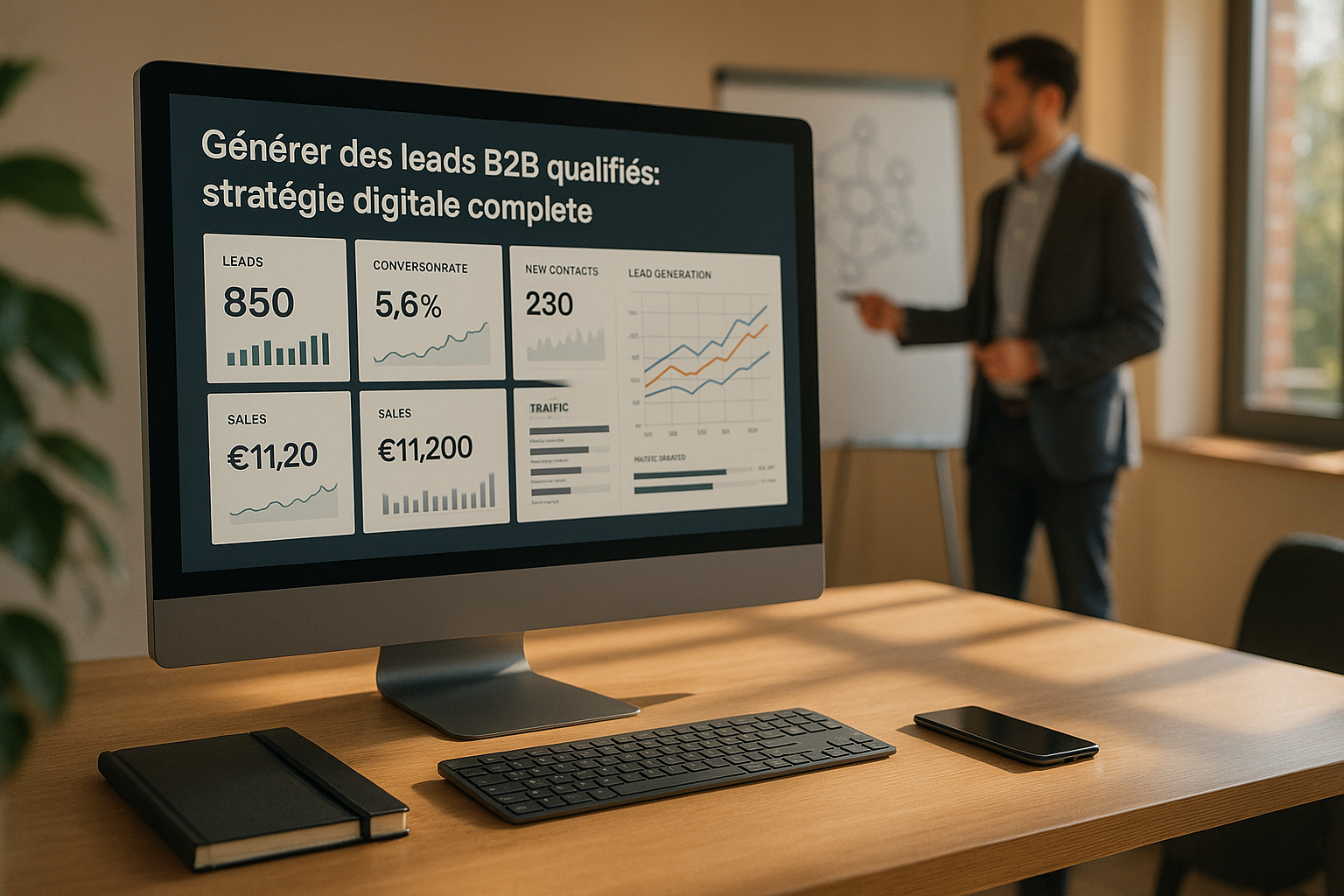
Generate qualified B2B leads: comprehensive digital strategy
Generate qualified B2B leads: complete digital strategy
Looking to attract qualified B2B prospects in Switzerland? Here are the key points:
- Understanding the specificities of the Swiss market: multilingualism (French/English), long sales cycles, and strict regulations like the LPD and GDPR.
- Investing in a multichannel strategy: bilingual SEO, targeted SEA, LinkedIn Ads campaigns, and .
- Optimizing your website: clear design, mobile-friendly pages, simple forms, and localized content.
- Automating and analyzing: use a powerful CRM to track prospects, prioritize efforts, and measure results.
In summary, a well-structured digital approach, combined with in-depth knowledge of the local market, will allow you to maximize conversions while meeting the high expectations of Swiss decision-makers.
B2B lead generation: 3 essential ingredients for success
Creating a multichannel digital strategy
To generate , an effective cannot rely on a single channel. In Switzerland, with its linguistic and regulatory specificities, it is crucial to adopt a coordinated approach by leveraging multiple levers. Each channel plays a specific role in the prospect's journey, from initial discovery to conversion.
The goal? Create consistent touchpoints that enhance your company's credibility at each stage. For example, a prospect may first discover your offer through a Google search, deepen their interest with downloadable content, and be reengaged via LinkedIn. This complementarity is particularly suitable for the long sales cycles typical of B2B in Switzerland. Let's see how to structure this multichannel strategy with key levers.
Using SEO and SEA to increase B2B visibility
Combining (SEO) and Google Ads campaigns (SEA) is an effective method to attract qualified prospects. SEO offers sustainable and reliable visibility, while SEA provides immediate results and allows for quick testing of different approaches.
In Switzerland, bilingual optimization is essential. Your content should cater to specific searches in French and English. For example, a technical director based in Geneva might search for software solutions using different terms depending on the language used.
SEA, on the other hand, allows precise targeting of searches with high commercial intent. Long-tail keywords like "CRM software for Swiss SMEs" or "project management solution Geneva" attract prospects who are already advanced in their decision-making process. A well-coordinated strategy between SEO and SEA offers many advantages: the can reveal the most effective keywords, thus guiding your organic content. Similarly, a strong natural presence on certain queries can guide your advertising investments.
To maximize conversions, optimize your pages with local elements: display prices in CHF, comply with Swiss standards, and highlight local references or relevant case studies.
Once your visibility is consolidated through SEO and SEA, it's time to target your decision-makers directly through LinkedIn campaigns.
Targeting professional audiences with LinkedIn Ads

LinkedIn is an essential tool for generating B2B leads in Switzerland. With over 3.2 million active professionals on the platform, accounting for a third of the active population [1], LinkedIn allows you to reach decision-makers directly.
You can segment your campaigns based on specific criteria: industry, company size, role, hierarchical level, or specific skills. For example, a cybersecurity company could target IT directors of medium-sized companies in the Geneva and Zurich regions.
Successful campaigns on LinkedIn achieve connection acceptance rates of 35 to 45% and positive response rates of 18 to 28% [1]. To maximize impact, use tailored advertising formats: Sponsored Content to appear in the news feed, Message Ads for personalized messages, and Lead Gen Forms that simplify information collection through pre-filled forms.
Adopt a progressive nurturing strategy to engage your prospects. Offer informative content first, such as a white paper on industry trends or a practical checklist. These formats are often more engaging than a direct commercial offer. Once the initial contact is established, you can retarget these prospects with messages more focused on conversion.
To fuel these interactions, content marketing plays a central role.
Content marketing and lead magnets
Content marketing is the engine of your multichannel strategy. In B2B, where sales cycles can last several months, offering relevant and high-quality content helps maintain prospects' interest while demonstrating your expertise.
Lead magnets, such as white papers, case studies, or practical guides, address specific needs. For example, a white paper on "Optimizing billing processes for Swiss SMEs" can attract prospects in the research phase, while a case study detailing how a Geneva-based company reduced costs can convince more advanced prospects.
Quality should always take precedence over quantity. A comprehensive guide, rich in concrete data and tailored to the Swiss market, will generate more qualified leads than a series of superficial content. Swiss decision-makers seek practical and data-driven solutions, supported by local examples.
Also, consider adapting your content to the Swiss context. Include references to local regulations, use relevant statistics, and include testimonials from recognized companies. This level of personalization immediately reinforces your credibility.
Distribute your content strategically: publish SEO-optimized articles to attract organic traffic, share engaging excerpts on LinkedIn, and use your lead magnets as incentives in your Google Ads campaigns. Each channel amplifies the effectiveness of the others, creating a coherent and effective multichannel strategy.
Finally, regularly analyze the performance of your content to adjust and improve your strategy continuously.
Design websites that convert visitors into leads
To succeed in your strategy, your website must transform every visitor into a qualified prospect. Attracting relevant traffic is a crucial first step, but without a design focused on conversion, your efforts may not yield results. In Switzerland, where standards of quality and professionalism are high, your site must inspire trust from the first seconds. Every element should guide your visitors towards a clear action: filling out a form, downloading content, or requesting a quote.
A in B2B goes beyond attractive design. It must meet the expectations of often busy decision-makers by offering precise information and reliable solutions. Navigation should be intuitive, content easily accessible, and calls to action clearly visible. In a multilingual country like Switzerland, your site must also adapt to linguistic and cultural specificities. This attention to detail helps maximize the results of your multichannel strategy. Here's how to structure your site to optimize lead generation.
Design landing pages that generate conversions
A has a single goal: converting visitors into leads. Unlike a homepage, it is entirely focused on this mission.
To be effective, a landing page must include several key elements. It all starts with a compelling headline that highlights the value of your offer. In Switzerland, clarity and precision are essential. For example, a headline emphasizing a measurable cost reduction through your CRM solution will have more impact than a vague slogan. The subheading should reinforce this promise with concrete details.
The contact form is the heart of your landing page, and its design directly influences your conversions. Ask only essential information: name, email, company, and phone number. Each additional field can deter users. If you offer a high-value proposition, such as a personalized consultation, you can include a few additional questions (industry, company size, estimated budget), but be concise.
To enhance credibility, display logos, certifications, and local testimonials. For example, a testimonial signed by a director of a Geneva-based SME will be more convincing than an anonymous review.
The call to action should be clear and compelling. Use action verbs like "Download the guide," "Request a demo," or "Get my free audit." Avoid overly general formulations like "Learn more." Ensure that the action button stands out visually with a contrasting color.
Also, consider visual hierarchy. Essential elements (headline, form, call to action) should be immediately visible without the need to scroll. Secondary information, such as technical details or an FAQ, can be placed lower. This structure naturally guides visitors to the desired action.
Finally, remember to integrate social proof and appropriate guarantees for the Swiss audience. Explicitly mention compliance with local regulations, display prices in CHF (including VAT if applicable), and specify your privacy policies. These details immediately strengthen trust with an audience attentive to these aspects.
Creating bilingual interfaces for Swiss users
Switzerland being a multilingual country, your site must reflect this diversity to effectively reach your B2B audience. Offering a seamless experience in French and English is not just a technical detail but a strategic necessity.
The language selection should be immediately visible, ideally in the site header. Use clear indicators like flags or language codes (FR/EN). Avoid automatic redirects based on location, as many Swiss professionals use English, even in French-speaking Switzerland.
Each version of the site should be localized, integrating language-specific expressions and references. For example, a testimonial from a Geneva-based company will be more relevant in French, while an internationally focused case study will be more suitable in English.
Use subdirectories or subdomains and configure hreflang tags to optimize your SEO. Also, translate all interactive elements, such as form fields, error messages, or submission confirmations, to ensure a consistent experience.
Terminological consistency is essential, especially in technical sectors. A glossary of key terms in each language can be useful to ensure clear and consistent communication.
Also, adapt your visual content. Screenshots, infographics, or other text-containing elements should be localized to match the language of the page being viewed. Once these adjustments are made, ensure that the mobile experience remains smooth and efficient.
Mobile-first design for lead capture
In Switzerland, the majority of web traffic comes from mobile devices. B2B decision-makers often browse professional sites from their smartphones, whether on the go or between meetings. If your site is not optimized for mobile, you risk missing out on many potential leads.
Adopting a means designing first for mobile screens, then adapting the design to larger devices. This ensures that essential elements, such as forms or calls to action, remain accessible and functional on all screen types.
Using CRM systems and automation tools
Without a well-chosen , prospects may slip through the cracks, and your team may waste valuable time on repetitive tasks. A CRM (Customer Relationship Management) paired with automation tools allows you to structure your lead generation process, automatically qualify your prospects, and track your results in real time.
Once your site is optimized for conversion, a powerful CRM becomes an essential ally to complement your multichannel strategy. In Switzerland, where B2B sales cycles are often long and involve multiple decision-makers, a CRM centralizes all interactions with your prospects, helps you prioritize your efforts, and provides a clear view of your pipeline. Automation, on the other hand, frees your team from administrative tasks, allowing them to focus on the essentials: building strong relationships and closing sales. Here are some tips for selecting and using these tools to maximize your results.
Selecting a CRM adapted to the Swiss market
For companies in Switzerland, choosing the right CRM requires special attention to several specific criteria.
- Legal compliance: Your CRM must comply with the Federal Act on Data Protection (LPD) and, if you have clients in the EU, with the GDPR. Check the location of the servers hosting the data. Servers located in Switzerland or the European Economic Area generally offer better guarantees. Also, ensure you can easily manage requests for access, rectification, or deletion of personal data.
- Multilingual support: In Switzerland, where multiple languages coexist, a CRM must allow managing contacts in French and English, with options for German or Italian if necessary. Multilingual interfaces are crucial to facilitate adoption by your team and segment your database according to each prospect's preferred language.
- Integration with your existing tools: Ensure your CRM can connect to your current tools such as your website, forms, email campaigns, or Google Analytics and LinkedIn Ads. Good integration reduces manual input and limits errors. CRMs with open APIs or ready-to-use connectors are often the most practical.
- User-friendliness: A CRM that is too complex may be underutilized. Test the interface with several members of your team to ensure that common tasks, such as adding contacts or creating tasks, are simple and quick.
- Scalability: Your CRM should be able to grow with your business. If you currently have a few hundred contacts but plan to reach several thousand in the coming years, ensure the system can handle this growth without requiring a costly migration. Also, consider costs per user and per contact, often displayed in CHF with 7.7% VAT included or specified.
- Customer support: Prefer customer support available in French and aligned with Swiss hours. Responsive assistance can make all the difference in case of technical issues or to set up complex automations.
- B2B features: A good CRM for B2B should allow managing multiple contacts within the same company, tracking interactions at different levels, and providing a clear view of the sales cycle. Reporting tools should also allow analyzing your performance by industry, company size, or region.
Automating lead qualification and scoring
Once your CRM is in place, automation becomes a key step to optimize lead management and qualification. Not all prospects have the same potential: some are ready to buy, while others are just exploring your offers. Automation helps you quickly identify the most promising prospects and focus your efforts where they will be most effective.
-
Lead scoring: This system assigns a score to each prospect based on predefined criteria, whether demographic (industry, company size, location) or behavioral (visited pages, opened emails, filled forms). For example, a financial director of a Geneva-based SME who has visited your pricing page multiple times and downloaded a case study will receive a higher score than a student who has simply visited your blog. You can, for example, assign:
- 20 points for downloading a white paper,
- 10 points for each visit to the pricing page,
- 15 points if the company has more than 20 employees,
- 25 points if the contact holds a decision-making position.
-
Automated workflows: These processes trigger specific actions based on prospect behaviors. For example, when a lead reaches a certain score, the system can:
- Automatically notify your sales team,
- Move the contact to a priority list,
- Send a sequence of personalized emails.
- Automatic segmentation and alerts: Classify your contacts based on their behavior and receive real-time notifications for important actions. For example, a French-speaking prospect in the banking sector who visits your site several times in a week will be placed in a different segment from an English-speaking contact in the technology sector who has only opened one email in three months. These segments allow you to personalize your communications, while alerts inform your team of high-potential prospects.
By combining CRM and automation, you structure your lead generation process, optimize your sales efforts, and improve your results without overburdening your teams. This approach provides you with the necessary tools to remain competitive in the demanding Swiss market.
Bilingual SEO for Swiss B2B audiences
To continuously attract qualified leads, it is essential to be present where your prospects are looking for solutions: on Google. In Switzerland, where Google dominates with a 86.91% market share