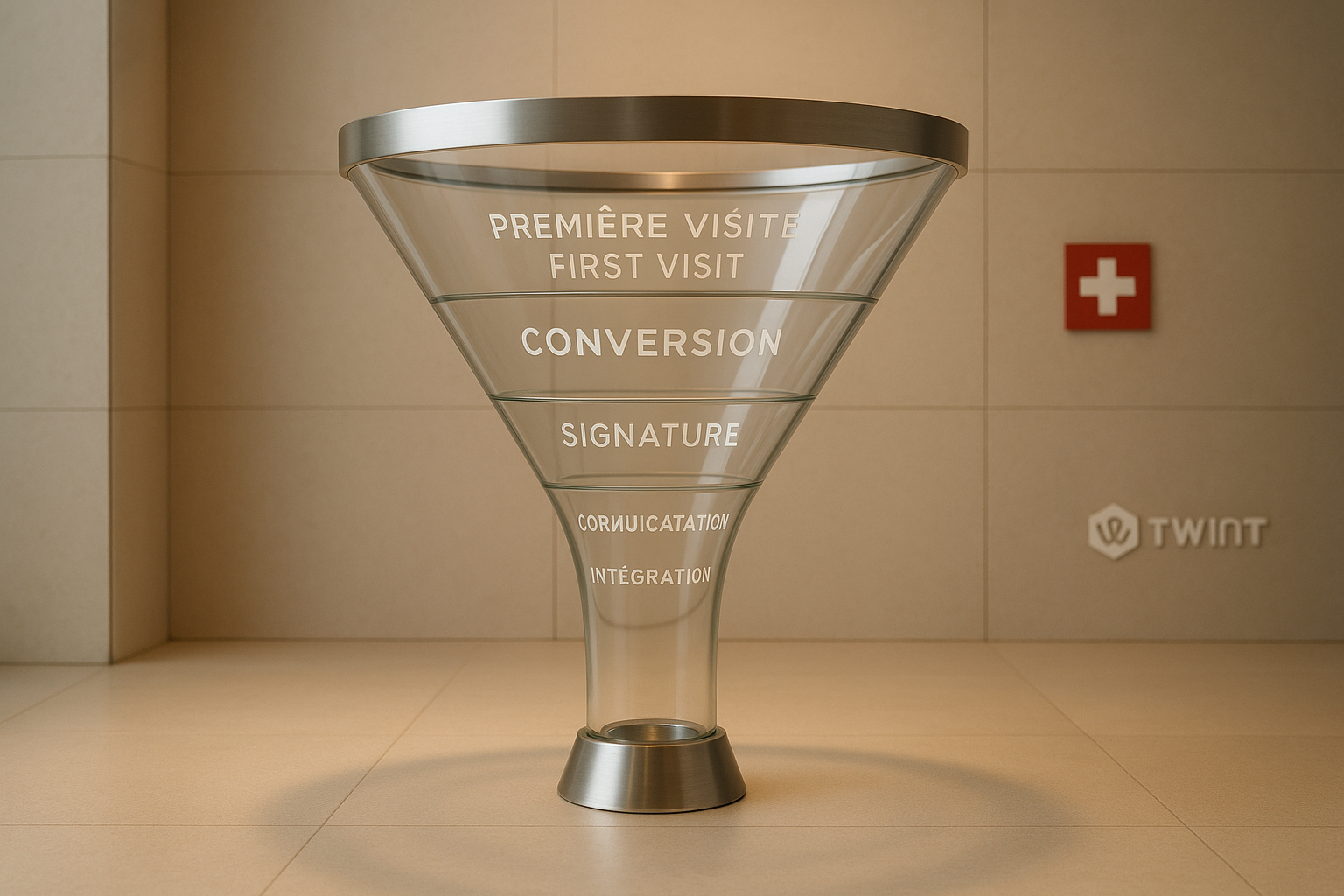
Optimized conversion funnel: from the first visit to the signature
Optimized conversion funnel: from the first visit to the signature
For businesses in Switzerland, where bilingualism and local expectations play a central role, every step of the customer journey must be smooth and well thought out. Here are the key points to remember to maximize your results without increasing your marketing expenses:
- Map your funnel: Visualize each step, identify friction points, and adapt your strategy for a bilingual audience (French and English).
- The 6 key stages: Discovery, engagement, consideration, lead qualification, negotiation, signature. Each requires specific actions to guide the prospect.
- Optimized touchpoints: Clear calls to action, accessible forms, and content tailored to both languages.
- Top of the funnel: Attract visitors with well-referenced bilingual content and a mobile-friendly experience.
- Mid-funnel: Convert visitors into leads through simple forms and an effective CRM.
- Bottom of the funnel: Facilitate signing or purchasing with clear proposals, local payment options (CHF, TWINT), and frictionless processes.
In Switzerland, trust is paramount. Display your local address, adhere to Swiss formats (CHF, dates, etc.), and ensure compliance with the LPD. By regularly analyzing your data and testing your actions, you can continuously adjust your funnel for optimal results.
A successful funnel is above all a clear, precise journey tailored to local needs. Mastering each step enhances your efficiency and optimizes your marketing investments.
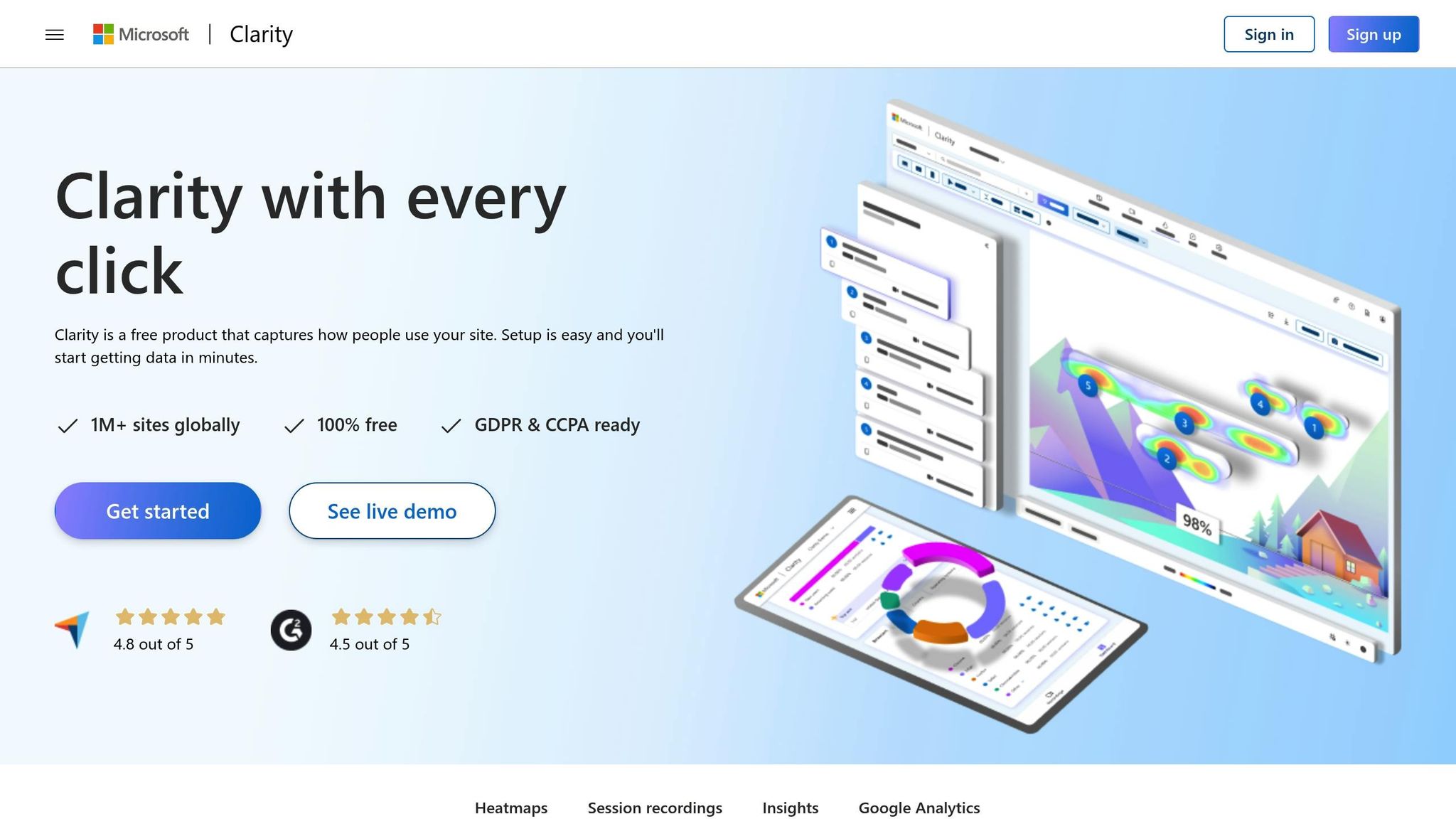
How To Find Optimizations in Your Sales Funnel (Microsoft Clarity)
How to Map Your Bilingual Conversion Funnel
Mapping your conversion funnel is essential to visualize each step, integrate the bilingual dimension, and consider local specificities. This helps you not to miss out on opportunities.
Start by analyzing your current situation: identify touchpoints, transitions, and drop-offs. This diagnosis helps identify weaknesses and optimize your investment, which is particularly crucial for a Geneva-based SME with limited resources.
The 6 stages of a Swiss business funnel
A funnel tailored to the Swiss market generally consists of six distinct stages, each with its own objectives and indicators. Although these stages may vary depending on your sector, they offer a clear structure to organize your strategy.
- Discovery: This is when a visitor discovers your company, often through a Google search, a recommendation, an article, or an advertisement. In Geneva, this stage must be effective in French and English. The goal is to capture attention and generate enough interest to encourage further exploration.
- Engagement: Here, the visitor starts interacting with your content, whether by reading an article, watching a video, or browsing multiple pages of your site. For example, an international NGO based in Geneva might observe a visitor reading a detailed report on its actions before visiting the "About" page.
- Consideration: The visitor actively evaluates your offer. They may download a document, sign up for a newsletter, or request information. For a luxury brand in Geneva, this could involve repeated visits to a product page, downloading a PDF catalog, or checking warranty conditions.
- Lead qualification: At this stage, you collect information to assess if the prospect fits your target. For example, a detailed contact form or a request for a personalized quote helps filter out genuinely interested prospects. A Swiss B2B company might ask for information such as budget, timeline, and specific needs.
- Negotiation: You present a concrete offer and discuss details with the prospect. This may include a commercial proposal, a demonstration, or exchanges to adjust the offer. In a bilingual environment, ensuring smooth communication in both languages is essential, especially for international organizations based in Geneva.
- Signature: This is the final stage where the prospect becomes a client, whether through signing a contract, finalizing a purchase, or making a formal commitment. For example, an e-commerce site should allow payment in CHF with options tailored to local services. For an agency, the contract signing must comply with Swiss legal standards, thereby reinforcing client trust.
These stages provide a framework to optimize each interaction with your prospects, a topic we will delve into further.
Touchpoints and Channels in Switzerland
Once your funnel is defined, focus on optimizing interactions at each touchpoint.
Your website is the heart of your funnel. It must offer a seamless experience in French and English, with intuitive navigation that facilitates switching between languages. A common mistake is to simply translate content without adjusting the message to local sensitivities. For example, an English-speaking visitor may prefer concise information, while a Swiss French speaker may appreciate detailed explanations.
Dedicated landing pages are crucial for promoting a service or capturing leads. A Geneva-based company could create separate pages for "consulting services" and "digital strategy consulting," optimizing SEO in both languages. These pages should load quickly, present a clear value proposition, and include a clear call to action.
The blog is a powerful tool for attracting visitors through content. Regularly publishing relevant content in French and English can improve your visibility on Google and strengthen your expertise. For example, a tech SME can publish technical articles in English for an international audience while offering content tailored to the Swiss market in French.
Contact forms play a key role but can also be a point of friction. A form that is too long can discourage prospects, while a form that is too short may not gather enough information to qualify leads. Finding the right balance depends on your sector and the sales cycle.
Automated emails help maintain engagement after the initial interaction. A well-thought-out sequence in French and English can deepen the relationship with the prospect by sharing case studies or guides, eventually leading to offering a free consultation.
Finally, social networks like LinkedIn are particularly useful for Swiss B2B companies. Sharing relevant content, engaging with your audience, and using targeted advertising can attract qualified leads and increase your visibility in the local and international market.
Top of Funnel: Attracting and Engaging Visitors
The top of the funnel is your first opportunity to make an impression. It involves attracting unknown visitors and establishing the foundations of your credibility as soon as they land on your site. For a company in Switzerland, paying special attention to local needs and linguistic expectations is crucial.
A visitor arriving on your site through a Google search or a LinkedIn recommendation decides within seconds whether to stay or leave. If the content is not in their language, if the site is slow to load, or if the design appears amateurish, they will leave immediately.
Creating Content for Bilingual Audiences FR/EN
To capture the attention of your French-speaking and English-speaking audiences, your content must be specifically tailored to each. Each language requires adjustments, both in terms of message and technical structure.
- Add a visible language selector: Place it at the top right of your site, with clear indicators like "FR" and "EN" or flags. Do not rely solely on automatic detection, as language preferences vary.
- Optimize your bilingual SEO: Use hreflang tags, for example:
<link rel="alternate" hreflang="fr-CH" href="https://yoursite.ch/fr/services" />
<link rel="alternate" hreflang="en-CH" href="https://yoursite.ch/en/services" /> - Adapt the tone and content: Swiss French visitors often prefer detailed explanations and a formal approach, while English speakers prefer direct and concise messages.
- Respect local formats: In French, write prices like "1'500.75 CHF" and dates in the format "07.12.2025". These details enhance your credibility with Swiss users.
Your strategy should also include specific keywords for each language. For example, a French speaker may search for "web agency Geneva," while an English speaker may type "web design agency Geneva." Translating your keywords is not enough; you must adapt them to the search habits of each audience.
Designing a Site for Swiss and International Visitors
Your site design should meet Swiss expectations while remaining accessible to a global audience. Mobile responsiveness is essential, as over 60% of web traffic in Switzerland comes from smartphones. Your site must offer a seamless mobile experience before considering desktop.
- Optimize loading speed: A site that takes more than three seconds to load loses visitors. Use modern image formats like WebP, enable caching, and reduce JavaScript code.
- Ensure accessibility: Include sufficient color contrast, readable fonts, and keyboard navigation. Alt tags for images and semantic HTML structure improve both accessibility and SEO.
- Simplify navigation: Menus should be intuitive and consistent across languages. A user switching from French to English should find the same structure and be redirected to the corresponding page, not the homepage.
The design should also reflect industry expectations. For example, a luxury brand in Geneva will require a sleek and elegant design with high-quality visuals, while an international NGO will focus on clear calls to action and engaging images. A B2B tech SME, on the other hand, will prioritize a modern and professional look to inspire trust and demonstrate expertise.
A well-thought-out design is not only aesthetic but also establishes a trust relationship from the first few seconds.
Building Trust with Swiss Visitors
In Switzerland, trust is essential for converting visitors into customers. Swiss users are demanding and cautious, but there are concrete ways to reassure them.
- Display your physical address: For example, a company based in Geneva can indicate "Quai Gustave-Ador 62, 1207 Geneva" in the footer and on the contact page. This shows that you are a real and well-established local business.
- Highlight your local presence: For a Swiss company, emphasizing its local roots can be a major asset, reinforcing credibility and user trust.
These simple yet effective elements lay the foundation for a strong relationship with your visitors from their first interaction.
Mid-Funnel: Converting Visitors into Qualified Leads
The mid-funnel is a key stage where your visitors transition from mere interest to real interaction. This is where you start turning curious visitors into potential leads by collecting their information, understanding their needs, and establishing an initial business connection. In Switzerland, where privacy and professionalism are highly valued, this stage requires a precise and respectful approach.
Designing Effective Forms
Forms are often the first direct interaction between you and your prospects. A poorly designed form can deter even the most interested visitors. The rule is simple: ask only what is strictly necessary. For initial contact, three or four fields are sufficient, such as name, email address, and optionally a phone number. If you target Swiss businesses, ensure the phone field accepts the local format (+41 XX XXX XX XX) to avoid any frustration.
To reduce drop-offs, consider multi-step forms. By dividing the process into multiple screens, you reduce the complexity perception and increase completion chances. If your audience is bilingual, offer versions in French and English, adapting not only the texts but also error messages and confirmations. A poor translation or an error message in an unexpected language can quickly erode trust.
Add privacy guarantees to reassure your visitors. For example, mention that their data is protected according to Swiss LPD or that you never share their information. To enhance your credibility, especially if you are a local business, display a physical address near the form.
Don't forget to test your forms on mobile. With over 60% of Swiss traffic coming from smartphones, a poorly adapted form can cost you valuable leads. Ensure the fields are easy to fill, the buttons are clickable, and the keyboard automatically adjusts to the field type (numeric, text, etc.).
Harnessing a CRM and Marketing Automation
Once leads are collected, their management becomes essential. A CRM allows you to centralize information and automate repetitive tasks. For example, instead of manually sending follow-up emails, set up automated sequences based on prospect actions. If a visitor downloads an SEO guide, they could receive a welcome email, followed by a relevant case study, then an invitation to discuss.
Adapt your workflows to the chosen language during registration and ensure your communications adhere to local conventions. In Switzerland, a professional tone is generally preferred, with greetings like "Hello Mrs. Dupont" and a signature including your full name and position.
Lead scoring is a powerful tool to identify those ready to move to the next stage. Assign points based on actions: a visit to the pricing page could be worth 10 points, while a demo request could be worth 50. Once a prospect reaches a certain score, they become "qualified" and can be passed on to the sales team.
Segmentation also improves the relevance of your communications. Create lists based on criteria like language, industry, or company size. For example, a Geneva-based SME in finance will have different expectations than an international NGO. With your CRM, you can personalize your messages based on these specific needs.
Finally, connect your CRM with your other tools for a seamless ecosystem. For example, sync your contact form with the CRM so that each lead is automatically recorded. Also, integrate your calendar to allow prospects to book an appointment directly, and link your data to your analytics tools to identify the most effective channels.
Measuring Mid-Funnel Performance
To optimize your efforts, closely monitor your key indicators. The visitor-lead conversion rate is a good starting point. For example, if your site receives 1,000 visitors per month and 50 become leads, your rate is 5%. In Switzerland, a rate between 2% and 5% is generally considered satisfactory, although it depends on your sector.
Also evaluate the lead-MQL (Marketing Qualified Lead) conversion rate. If out of 50 leads, only 10 reach the MQL status, that represents a 20% rate. This figure reflects both the quality of your traffic and the effectiveness of your nurturing.
Analyze friction points to understand where your visitors are dropping off. For example, if 500 people start filling out a form but only 200 complete it, that indicates a problem. Perhaps the form is too long or presents technical obstacles. Tools like Google Analytics or Hotjar can help you pinpoint these abandonment areas.
Lastly, measure the conversion time, i.e., the time between the first visit and form submission. For a Geneva-based B2B company, this time can range from a few days to several weeks. If your average is 12 days, consider strategies to maintain prospect interest during this period.
By monitoring and adjusting your strategies based on this data, you can continuously improve your results and maximize your conversions.
sbb-itb-454261f
Bottom of Funnel: From Proposal to Contract Signing
At the bottom of the funnel, your prospects are ready to take action. At this stage, it is crucial to eliminate anything that could hinder their decision. A complex signing process, unclear documents, or unsuitable payment options can deter even the most motivated buyers. This stage naturally finalizes the work initiated in the previous phases.
Creating Proposals and Contracts that Encourage Action
Your contracts must be clear, professional, and tailored to the Swiss market. Offer your documents in French and English to reassure your