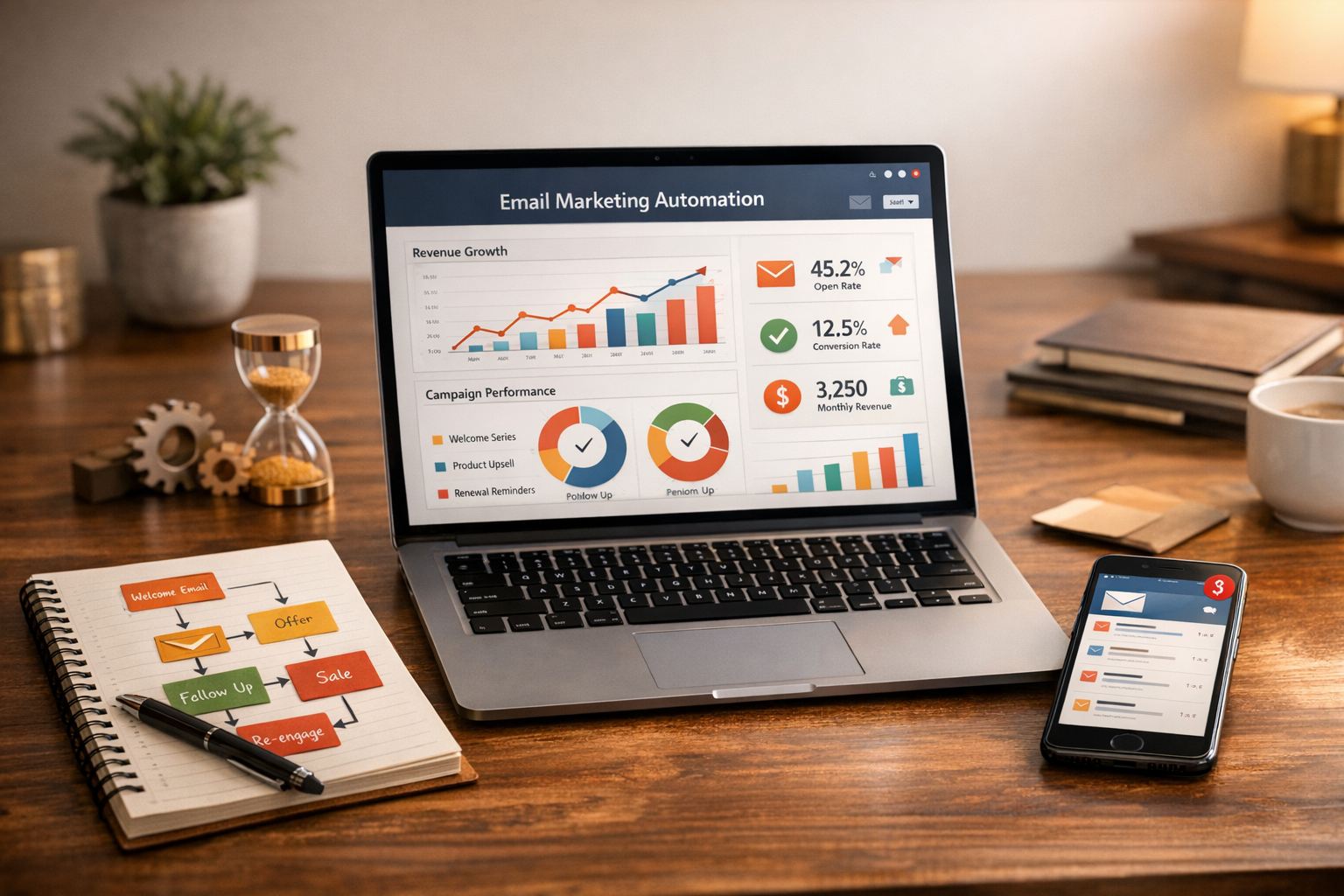
Email marketing automation: scenarios that generate recurring revenue
Email marketing automation: scenarios that generate recurring revenue
The is an effective solution to increase your revenue while reducing manual efforts. With targeted scenarios, you can turn every customer interaction into a sales opportunity. Here are the 4 key scenarios to maximize your results:
- Recovery of abandoned carts: Follow up with customers and recover up to 11% of lost sales.
- Renewal reminders: Increase loyalty with strategic reminders 30, 7, and 1 day(s) before the deadline.
- Upsell campaigns: Offer superior versions or complementary products to boost your sales.
- Reactivation of inactive customers: Win back dormant customers with tailored offers.
Swiss companies, like On Running, generate up to 20% of their revenue through these automations. By combining local personalization (language, CHF, date format) and , you can optimize your strategy while meeting the expectations of Swiss consumers.
Ready to maximize your revenue through automation? Discover how these scenarios can transform your marketing approach.
[Comparison of the 4 email marketing automation scenarios for recurring revenue]
Scenario 1: Recovering abandoned carts
Configuring abandoned cart emails
The recovery of abandoned carts is based on a series of three emails sent at specific intervals. The first email, sent an hour after abandonment, serves to remind the customer of their pending purchase. The second, sent 24 hours later, aims to reassure by highlighting elements such as customer reviews, company values, or answers to frequently asked questions. Finally, the third email, sent between 72 hours and 7 days after abandonment, offers an incentive such as a discount or free shipping.
Each email should include key elements: the name of the product, high-quality photos, details like size or color, a clear call-to-action button, and customer service contact information. Interestingly, it is not always necessary to offer a discount to convince customers to complete their purchase. Brand values and testimonials can be equally effective.
These strategies should then be adjusted to the specificities of the Swiss market.
Personalizing content for Swiss audiences
To appeal to Swiss consumers, local adaptation is essential. Prices should be displayed in Swiss francs (CHF) and adhere to the local format (e.g., CHF 49.90 or 49.90 CHF). Swiss customers appreciate a service-oriented approach rather than overly aggressive sales techniques. For example, the first email can take the form of a friendly question: "Did you encounter a technical issue during your order?"
Prefer a personalized and identifiable email address (e.g., firstname@company.ch) instead of a "no-reply" address to encourage responses and enhance the human aspect of your brand. Personalized emails can generate up to 10% additional conversions, and a well-designed sequence of three emails can achieve conversion rates exceeding 32%. By integrating dynamic blocks that automatically display images and names of abandoned products, you increase relevance and engagement.
Adding incentive and cross-selling
Abandoned cart emails are also an excellent opportunity to suggest complementary products or superior versions. Upselling involves offering an upgraded version of the abandoned item, while cross-selling highlights accessories or associated products. To make these suggestions effective, ensure that the price difference remains reasonable. For example, offering a product at CHF 500 as a replacement for an item at CHF 100 may discourage the buyer.
You can also offer bundles combining the abandoned item and a complementary product at an attractive price. Use comparison tables to illustrate the benefits of a premium product and add specific customer reviews to enhance credibility. A "Update Cart" button simplifies the user experience by allowing the customer to directly add the recommended product without additional effort. Knowing that an existing customer has a 60 to 70% chance of repurchasing compared to only 5 to 20% for a new prospect, this strategy optimizes each interaction.
Marketing Automation - The 5 ESSENTIAL scenarios
[YouTube video embedded]
Scenario 2: Subscription renewal reminders
After working on recovering abandoned carts, let's focus on subscription renewal reminders, an essential lever to strengthen .
When to send renewal emails
Schedule your reminders 30, 7, and 1 day(s) before the expiration date to maximize engagement. These automated emails, sent at strategic times, achieve up to 5 times more openings and 15 times more clicks than traditional newsletters.
For Swiss companies, it is crucial to synchronize these sends with their CRM so that each reminder is sent at the precise moment, based on the recorded expiration data. You can also consider a final reminder 1 to 3 days after expiration, adding a special offer to reactivate the subscription or a feedback request.
Using dynamic content
A simple reminder is not enough. To be effective, renewal emails must demonstrate the added value of the subscription. Integrate personalized elements such as usage statistics, milestones reached, or a summary of the benefits obtained during the subscription period. For example, some brands highlight weekly achievements to motivate customers to renew.
Personalized campaigns can generate up to 6 times more conversions, while automated flows represent between 20% and 30% of total revenue generated by email. Also, include recommendations based on purchase history and offer a small discount or loyalty reward for customers who renew before the deadline. Finally, ensure that the "Renew Now" button is clearly visible and optimized for mobile, as nearly half of email marketing is viewed on smartphones.
Adapting for Swiss markets
In the Swiss market, a simple translation is not enough: localization must be carefully done. Respect the local date format (e.g., 15.03.2026 for a mid-March deadline) and display amounts in Swiss francs according to local conventions (CHF 89.90 or 89.90 CHF). The Swiss brand On Running, for example, generates 20% of its e-commerce revenue through email automation, using targeted content based on customer interests and activity.
"A country with three official languages deserves a tool capable of delivering a marketing campaign in multiple languages" - Vibetrace
To maximize engagement, segment your audience based on their preferred language (German, French, Italian) and tailor your messages to local sensitivities. Swiss consumers prefer a service-oriented approach, emphasizing support and continuity rather than aggressive sales strategies. Also, ensure that your campaigns comply with GDPR and Swiss data protection standards, always including a clear unsubscribe option.
Scenario 3: Personalized upsell campaigns
Leverage upselling to turn your existing customers into regular buyers through well-thought-out automated campaigns.
Segmenting by purchase history
Segmentation is essential for successful upsell campaigns. Divide your customers based on their purchase history: occasional buyers, regular customers, or even by the average value of their orders. This method quickly identifies the 20% of customers who generally generate 80% of your revenue.
Take the analysis further by considering each customer's lifecycle stage. For example, a new customer will not have the same expectations as a loyal user active for several years. Also, use UTM parameters to track their behavior after clicking.
Email tools integrating artificial intelligence can generate up to 571% additional revenue through advanced personalization. In the Swiss market, adjust your segments considering languages and regions. A German speaker in Zurich will react differently from a French speaker in Geneva to the same offer.
These precise segments will allow you to trigger targeted and effective upsell workflows.
Building the upsell workflow
Once your segments are defined, set up automated workflows based on specific behaviors. For example, send an email when a customer reaches 80% of their usage limits, celebrates a subscription anniversary, or views a product category without completing a purchase.
Timing is crucial, especially for B2B audiences in Switzerland. Prefer sending emails in the mid-morning on weekdays. Test precise delays, such as an email sent 30 to 60 minutes after viewing a premium feature, or 24 to 48 hours after a purchase to offer complementary accessories.
In your messages, highlight concrete benefits rather than technical details. For example, explain how an upgrade can solve a business problem or improve a company's efficiency. Support your arguments with social proof like case studies or customer testimonials to reassure decision-makers about the investment. Automated emails achieve 70% higher open rates than manual campaigns. Therefore, ensure your messages are optimized for mobile and include a clear and visible call to action.
Creating offers for Swiss customers
Move from segmentation to action by adapting your offers to the specificities of the Swiss market. Respect the 80/20 rule: 80% informative content and 20% promotional content. Swiss consumers appreciate precise information and detailed comparisons between different options.
For limited-time promotions, be direct: for example, "20% off for 48 hours." Regular customers spend an average of 32% more than new customers and are 50% more likely to try new products.
Finally, offer a preference center where customers can adjust email frequency to avoid saturation. Brands mastering personalization can increase their revenue by 40%, and 91% of consumers prefer companies offering personalized and relevant proposals.
[FAQs]
Conclusion
Email marketing automation represents an effective method to generate recurring revenue. The examples mentioned - recovering abandoned carts, renewal reminders, personalized upsell campaigns, and re-engagement of inactive customers - help guide your customers at each stage of their journey