
How to overcome the obstacles of digital transformation
How to overcome the obstacles of digital transformation
Digital transformation is no longer an option, but a necessity for Swiss SMEs. However, it comes with major challenges: lack of financial resources, shortage of technical skills, resistance to change, and outdated infrastructures. These obstacles hinder their ability to remain competitive in an ever-evolving market.
Key points to remember:
- 66% of Swiss SMEs consider digitalization urgent, but 26% are lagging behind.
- Digitized companies increase productivity (+65%) and save up to 25% of working time.
- Costs range from CHF 10,000.– for simple tools to several hundred thousand for complex projects.
Main solutions:
- Clear plan: Evaluate your digital maturity and define a roadmap aligned with your goals.
- Continuous training: Strengthen internal skills and reduce resistance to change.
- Progressive modernization: Integrate flexible tools (CRM, ERP) tailored to your needs.
- Rigorous budget management: Prioritize projects with quick ROI and optimize resources.
Digital transformation is an ongoing process that requires a thoughtful strategy, motivated teams, and suitable tools. In Switzerland, partners like or networks such as Platinn can effectively support SMEs in this transition.
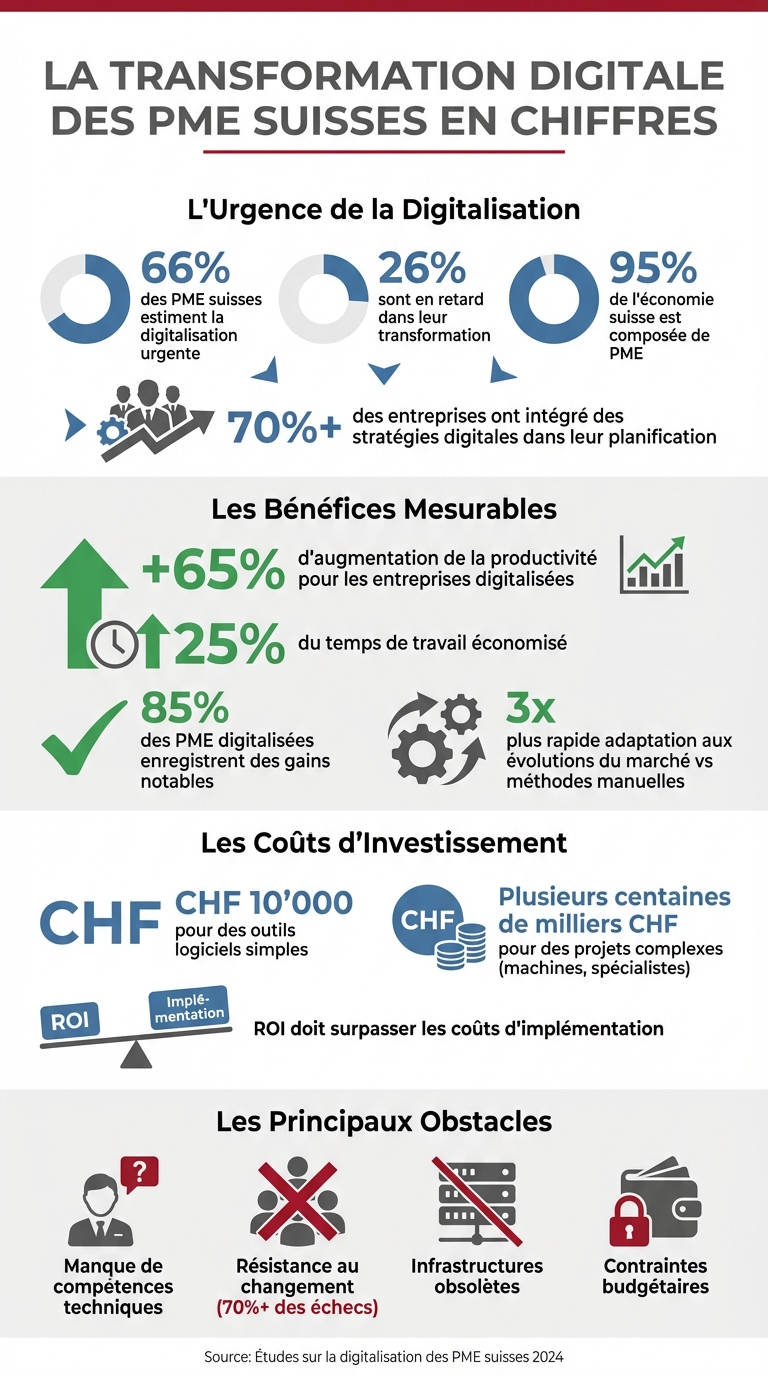
Key statistics of digital transformation of Swiss SMEs
Digital transformation: risks & opportunities for Swiss SMEs | Yves Robert-Tissot, Inoshift
Main obstacles to digital transformation in Swiss SMEs
Even though 66.6% of Swiss SMEs acknowledge the urgency of digitalization [3], numerous barriers slow down their progress. These challenges involve strategy, skills, organization, and financial resources. Let's dissect these obstacles into four main axes.
Strategy and organization issues
A large number of Swiss SMEs embark on digital projects without a clear roadmap linking technological changes to their business objectives [10]. This lack of strategic vision can quickly complicate things: new tools intertwine with existing systems, leading to blockages and budget overruns [10] [11].
Furthermore, the lack of strategic alignment and rigid organizational structures hinder collaboration [10]. It is not uncommon for business needs to differ from solutions developed by technical teams, often resulting in tool rejection by users [11].
"Digital transformation is less about tools and more about trials." – Quixy Editorial Team [10]
These strategic gaps highlight another major challenge: the lack of skills needed to successfully carry out this transition.
Challenges related to skills and employees
Swiss SMEs often suffer from a lack of technical skills and a lack of time to support digital transformation [4]. The rapid evolution of technologies renders skills obsolete, directly jeopardizing their competitiveness [4]. Digital maturity relies on two pillars: an understanding of digital products by employees and expertise well integrated into the company's development [5].
Additionally, resistance to change represents a serious obstacle. Employees, accustomed to established work methods for years, may perceive digitalization as a threat rather than an opportunity. This reluctance can slow down or even block the adoption of new tools.
These human challenges are also accompanied by complex technological constraints.
Technological and data management issues
Aging IT infrastructures and their integration with modern solutions pose significant challenges [4] [5]. Many SMEs use isolated systems, creating technological islands that prevent unified data management.
Data security is another major concern. Between compliance with the Federal Data Protection Act and increasingly frequent cyberattacks, SMEs are facing growing pressure to implement strong security systems [1]. In a digital environment, security is no longer a luxury but a necessity [3].
These technological challenges add to often difficult-to-overcome financial constraints.
Budgetary and resource limitations
Financial uncertainty remains one of the main obstacles. Estimating the return on investment (ROI) of a digital project is complex, and costs can quickly escalate [4] [3]. For example, implementing software can cost as low as CHF 10,000.–, while more ambitious projects involving new machinery or hiring specialists can reach several hundred thousand francs [4].
These financial constraints, combined with a lack of time, often lead SMEs to delay their digital transition despite its urgency [3]. Moreover, teams, already busy with day-to-day operations, struggle to allocate resources to manage these complex projects.
| Obstacle | Direct Consequences |
|---|---|
| Lack of strategic alignment | Blocked projects and conflicting priorities [10] |
| Rigid hierarchies | Silos hindering communication [10] |
| Scope creep | Budget overruns [11] |
| Low user adoption | Tool rejection and nonexistent ROI [11] |
Recognizing these obstacles is an essential step to design tailored solutions, which we will address in the following sections.
How to overcome the obstacles of digital transformation
Successful digital transformation relies on a well-defined strategy, skills development, adoption of modern technologies, and effective resource management.
Create a clear digital plan
The first step is to assess the digital maturity of your company. In Switzerland, over 70% of companies have already integrated digital strategies into their long-term planning [1]. However, many still lack a detailed roadmap. For this, you can use questionnaires or seek experts to conduct a precise assessment [5] [6].
"Transformation starts with the problem, not the technology." – KPMG Switzerland [7]
Once this assessment is done, focus your strategy on business problems to solve rather than the technology itself [7]. For example, prioritize projects offering quick and measurable ROI. Automating repetitive tasks, for instance, can free up to 25% of employees' working time for higher value-added activities [3]. Also, ensure your plan complies with the Federal Data Protection Act requirements [1].
For SMEs with limited resources, agencies like offer comprehensive support, from defining the strategy to execution, with an ROI-focused approach tailored to the Swiss context.
| Step | Action | Area of intervention |
|---|---|---|
| 1 | Evaluation of maturity | Technical skills and internal motivation |
| 2 | Market analysis | Identify customer needs and suitable technologies |
| 3 | Internal audit | Review current processes, data, and performance |
| 4 | Strategy definition | Set clear and measurable objectives |
| 5 | Development of a roadmap | Prioritize and plan projects |
| 6 | Change management | Train teams and adjust corporate culture |
| 7 | Implementation and optimization | Deploy solutions and refine marketing actions |
A well-structured digital strategy is the foundation for strengthening internal skills and moving towards modernization.
Addressing the skills gap
The lack of technical skills is a major challenge for Swiss SMEs [4]. To address this, invest in continuous training. Swiss universities offer courses, workshops, and conferences to help your teams stay up to date [4]. Identify "change ambassadors" within your organization to guide and reassure your teams [8] [9].
You can also engage external experts to enhance your internal capabilities. Organizations like Platinn in French-speaking Switzerland offer specialized coaching to support companies in their digital transformation [6]