
ChatGPT and content marketing: increase without dehumanizing
ChatGPT and content marketing: increasing without dehumanizing
ChatGPT can accelerate , but without human intervention, it risks lacking depth and personalization. Here's what you need to know to leverage it while maintaining an authentic connection with your audience:
- Rapid production: ChatGPT can reduce 40% of the time .
- Decreased engagement: Content unsupervised by humans can lead to a 22% decrease in engagement rate.
- Trust challenge: 62% of consumers are wary of AI-generated content when not clearly identified.
- Local specifics: In Switzerland, regional and linguistic expectations (French, German, Italian) require specific adjustments to avoid generic content.
The goal? Use ChatGPT for repetitive tasks while letting humans handle the strategy, emotion, and authenticity. This guide explains how to balance to maximize the impact of your content.
How to boost your content with AI while staying authentic?
What ChatGPT can and cannot do
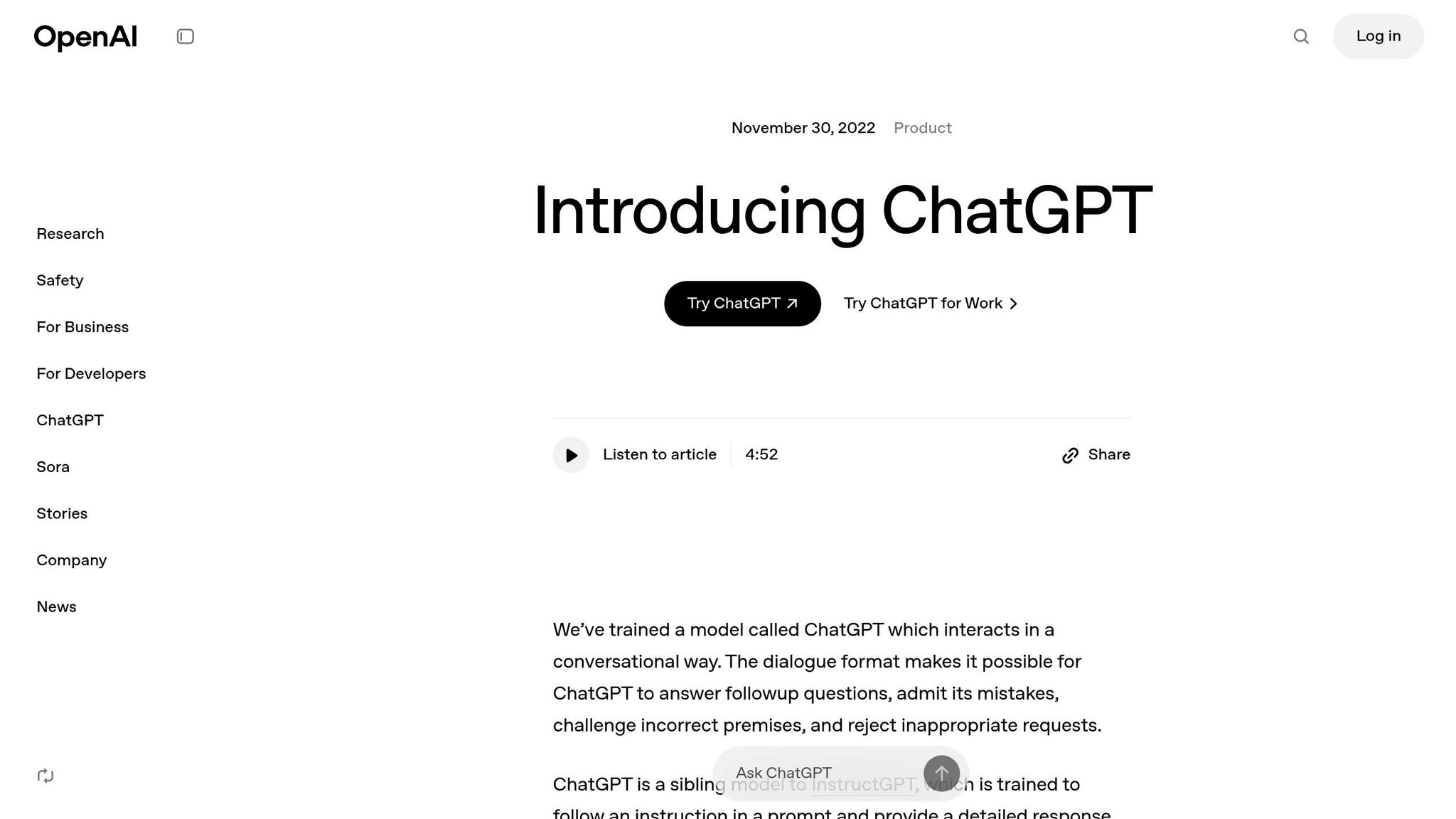
ChatGPT is a powerful tool for , but it's essential to understand its capabilities and limitations to avoid any disappointments. Currently, 78% of companies integrate AI into their marketing strategies, and ChatGPT is among the most accessible solutions [1]. However, this popularity doesn't mean the tool can accomplish everything without human intervention. Here's an overview of its strengths and weaknesses.
The strengths of ChatGPT in content marketing
ChatGPT excels in several areas that accelerate content creation. It can quickly generate ideas, suggest catchy titles, and identify related themes. For example, a company based in Geneva wishing to address could leverage sub-topics like cybersecurity, or cloud adoption.
Another advantage is its ability to produce multilingual content, a valuable asset in Switzerland. Whether in French, German, or Italian, ChatGPT can write in multiple languages, although a review is necessary to ensure that local and cultural nuances are respected.
In terms of SEO, ChatGPT helps identify relevant keywords, structure optimized articles, and write meta-descriptions. These features simplify and speed up the editorial planning phase.
The tool also facilitates content personalization. It adjusts the tone, complexity, and examples based on the target audience, whether business decision-makers or individual consumers.
The limits of AI
Despite its qualities, ChatGPT also has notable limitations. OpenAI itself admits that:
ChatGPT sometimes writes plausible-sounding but incorrect or nonsensical answers
[5]. This phenomenon, known as hallucinations, can lead to factual errors, jeopardizing a brand's credibility.
Additionally, content generated by ChatGPT often lacks personality and a distinctive brand voice. For a Swiss company where precision and reliability are paramount, the AI's generic tone requires human intervention to align the content with the brand's real identity.
Without specific business context, ChatGPT can produce messages ill-suited for a long-term strategy. Emotional and regional nuances often escape the tool. In environments where discretion and respect for local specificities are essential, especially in Geneva, AI does not replace human sensitivity.
Finally, its knowledge is limited to a previous date [2][4], restricting its ability to address recent topics or regulatory changes.
The risks of excessive use of AI
Relying too heavily on ChatGPT can harm content effectiveness. The main danger lies in producing generic content: when multiple companies use similar queries, the results become interchangeable, weakening brand differentiation and reducing reader engagement.
SEO issues can also arise. Search engines penalize low-quality content, and superficial text can lead to low reading time or high bounce rates, affecting ranking.
Information accuracy is also a challenge. With an accuracy rate of 88.7% for ChatGPT 4-o [3], about one in ten responses may be incorrect. This poses a problem for technical, financial, or regulatory topics that require absolute rigor.
Furthermore, both free and paid versions of ChatGPT impose limits on the number of messages and words [3][4].
The best approach is to use ChatGPT for repetitive and time-consuming tasks - such as initial research, generating variations, or structuring - while entrusting strategic supervision, creativity, and fact validation to human teams.
Adapting ChatGPT to your brand voice
The key to transforming bland text into content that truly captures your audience's attention lies in the brand voice. While ChatGPT can generate thousands of words in an instant, without clear instructions, the result may lack personality and resemble that of any other company using AI. The goal? Train the tool to adopt your unique style.
How to convey your brand guidelines to ChatGPT
The quality of the content depends directly on the accuracy of the instructions you provide. A vague prompt produces generic text, while a detailed prompt aligns the content with your identity.
Start by creating a reference document that clearly defines your voice, tone, values, as well as examples of phrases or terms that reflect your style. For example, a bank based in Geneva might opt for a reassuring and formal tone, while a tech startup would adopt a more energetic and modern style.
Incorporate these elements into your prompts. For example, instead of simply asking, "Write an article on cybersecurity," be specific: "Write an article on cybersecurity for Swiss SME financial directors. Use a professional yet accessible tone, avoid technical jargon, and include concrete examples tailored to the Swiss regulatory framework. Prefer a direct style with short sentences."
You can also include two or three examples of your best articles directly in the prompt. This helps ChatGPT grasp concretely what it means to "write like your brand."
Finally, establish a list of terms to use or avoid. For example, if you prefer "client" over "consumer" or "solution" over "product," specify that. For Swiss companies, it is often essential to use "CHF" rather than "Swiss francs" and to adopt formulations that respect local sensitivities.
Also, provide a clear role for ChatGPT: "You are a digital transformation consultant with 15 years of experience with Swiss companies. You explain complex concepts in a simple and accessible way for non-technical decision-makers." Such an approach guides the AI towards more relevant responses.
Finally, specify the desired format and structure to reduce the need for corrections.
Adapting content to Swiss markets
Switzerland has linguistic and cultural specificities that require special attention. Content that works in Paris or Lyon may not necessarily be effective in Geneva or Lausanne.
Multilingualism is essential. Even if you write in French, your audience may include German-speaking or Italian-speaking readers. Although ChatGPT can translate content, a simple translation is not enough. Each language region has its own references and expectations. For example, content intended for French-speaking Switzerland must include local examples, specific references, and respect Swiss writing conventions.
Also, respect local standards for amounts and dates (e.g., CHF 50,000.–, 04.12.2025). These details enhance the credibility of your content and show that you understand your audience.
Swiss tone and values play a crucial role. Swiss business culture values discretion, precision, and reliability. A tone that is too promotional or exaggerated promises may not be well received. Guide ChatGPT towards a measured and factual tone: "Avoid superlatives and focus on concrete data and a professional style."
Local references make your content more relevant. Instead of using generic international examples, integrate Swiss cases. If you talk about digital transformation, mention cantonal initiatives or local companies. When addressing regulations, refer to Swiss laws. Guide ChatGPT by specifying: "Use examples specific to the French-speaking Swiss context."
Lastly, be attentive to regional differences. German-speaking Switzerland and French-speaking Switzerland have distinct business approaches. Content intended for Zurich may adopt a more direct and efficiency-focused tone, while text for Geneva might favor a more diplomatic and relational approach.
These adjustments ensure better in your processes while preserving your .
Examples: generic content vs. brand-aligned content
Here is a concrete illustration of the impact of guidelines on content.
Example 1: Introduction of an article on cybersecurity
Generic version (without specific guidelines):
"Cybersecurity has become a major issue for modern businesses. With the increase in cyberattacks, it is essential to protect your data. In this article, we will explore best practices to secure your company against online threats."
Adapted version (with brand guidelines for a Swiss company):
"Swiss SMEs face increasing risks of cyberattacks. For a financial director, this means potential impacts on operational continuity and regulatory compliance. Here's how to concretely assess your level of protection and identify priority vulnerabilities."
Using ChatGPT to work more efficiently
Integrating ChatGPT into your processes can help you save time to focus on strategy, creativity, and customer engagement. This type of AI is particularly useful for managing repetitive and time-consuming tasks, freeing up resources for higher value-added activities. Let's look at two concrete uses: idea generation and content planning.
Generating ideas and planning content
ChatGPT is an excellent tool to overcome writer's block and quickly find relevant ideas.
Instead of spending hours searching for interesting angles, use AI as a brainstorming partner. For example, if you are a marketing manager for a fiduciary company based in Geneva that supports startups, you could ask: "Propose 15 article topics for tech SME founders in French-speaking Switzerland, focused on taxation, accounting, and regulatory compliance."
To enrich your ideas, combine multiple sources like current trends, frequently asked client questions, or gaps in existing content. You could ask: "What digital transformation themes interest Swiss SMEs but are underexplored in French content?"
For editorial planning, ChatGPT can structure a complete calendar in minutes. Provide your quarterly goals, key events, and seasonal constraints. For example, a B2B company in Lausanne could ask: "Create a content calendar for the first quarter of 2026 with two blog posts per week, four weekly LinkedIn posts, and a monthly newsletter. Consider business closures and local economic events."
ChatGPT can also adapt a topic into multiple formats to maximize its reach. Take the theme of "Electronic Invoicing in Switzerland": it can become a detailed article, a series of LinkedIn posts, an infographic, a video script, or even a . This ensures consistency while optimizing the use of each idea.
However, it is essential to tailor AI suggestions to your context. For example, instead of a generic topic like "The Benefits of Cloud Computing," rephrase it as "How Geneva SMEs can reduce IT costs through a secure cloud migration compliant with Swiss standards."
Producing content for multiple languages and channels
Creating multilingual content requires precise adaptation to the local context. ChatGPT can speed up this process, especially for the main national languages, provided that regional specificities are respected.
For multi-channel production, structure your requests. For example, start with a long article and ask for specific variations: "Turn this 1,200-word article into five 150-word LinkedIn posts, each with a clear call to action." Or: "Create three versions of this text: one for our newsletter (warm tone, 300 words), one for our blog (expert tone, 800 words), and one for Twitter/X (engaging tone, 280 characters)."
For , ChatGPT can write complete sequences. A financial services company could request: "Write a sequence of three emails to introduce our new sustainable investment advisory service. Email 1: problem identification (150 words). Email 2: presentation of our solution (200 words). Email 3: client testimonial and call to action (180 words). Formal yet accessible tone, tailored to Swiss SME executives."
Each channel has its own requirements. LinkedIn favors a professional tone with concrete information, while Instagram requires more visual and emotional content. Be specific in your instructions: "Write a 200-word LinkedIn post about our participation in the SwissTech fair in Lausanne. Include three key points we learned and end with a question to encourage engagement."
Finally, tailor each message to your audience's specificities. A blog article can delve into a topic in detail, while an Instagram post should be simple and impactful. ChatGPT can adjust the same message for different formats, but it is essential to provide clear instructions.
Why human revision remains essential
Even though ChatGPT speeds up content creation, human intervention remains crucial.
Each generated text must be carefully reviewed before publication. This includes fact-checking to avoid errors, especially for details like amounts in CHF, dates in Swiss format (04.12.2025), or compliance with local regulations.
Consistency control is also essential. Isolated content may seem relevant but risk subtly contradicting a previously published message. Your team must ensure that each element fits harmoniously into your overall strategy.
Finally, adjusting the tone and local contextualization requires a sensitivity that AI does not yet possess. ChatGPT can produce correct but sometimes impersonal text. A human editor can add personal touches, such as a local anecdote or a more natural wording, to make the content more engaging and relevant.
Moreover, an in-depth knowledge of the Swiss market is essential to properly contextualize the content. For example, a Geneva cantonal law may differ from that of Zurich, or a specific reference may work better in French-speaking Switzerland than in German-speaking Switzerland. These subtle adjustments transform generic text into content truly tailored to your audience.
Tracking results and improving your AI strategy
To assess whether ChatGPT adds real value to your content or simply produces text, you need to monitor specific indicators. These data will allow you to continuously adjust your strategy and maximize your results.